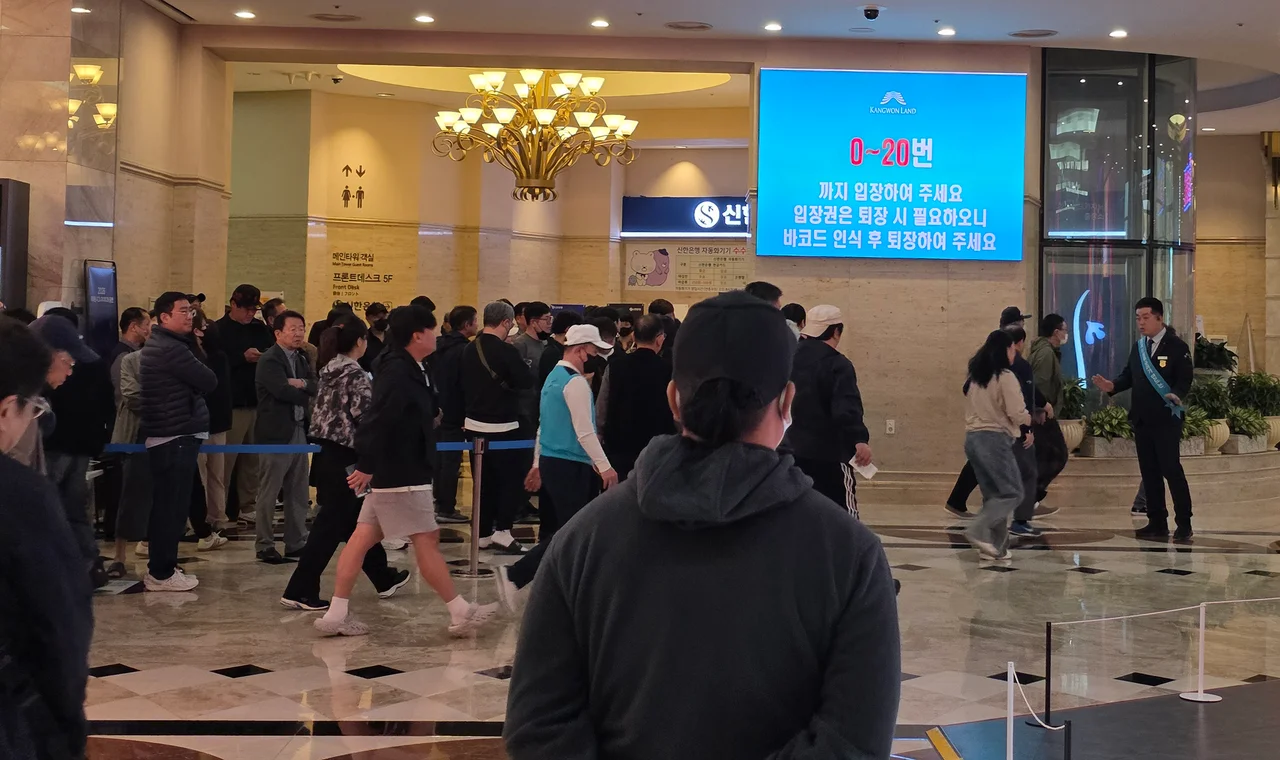

October 28, 2000. An event that changed the history of South Korea's casino industry took place in a small, abandoned mining town in Gohan-eup, Jeongseon-gun, Gangwon-do.
Kangwon Land, the only casino in the country where locals are permitted to enter, opened its doors.
Few expected that a small casino born to revive the economy of a former mining region would eventually transform the entire Korean casino industry and the nation's casino culture.
However, 26 years later, the legacy left by Kangwon Land goes far beyond the success of a single casino enterprise.
It catalyzed the growth of professional casino training, university education, and related industries, while serving as a gateway for the general public to familiarize themselves with casino games that were once considered foreign.
This is why the industry refers to Kangwon Land as a 'Casino Military Academy.'
Dealers who gained experience at Kangwon Land moved on to other casinos, and customers who were first introduced to baccarat, blackjack, and slot machines expanded their horizons to overseas casinos in Macau, the Philippines, and Vietnam.
During the same period, a major transformation occurred in the Asian casino market.
Macau opened up its monopoly, and Singapore built world-class Integrated Resorts (IR). The Philippines grew into a destination for global casino investment, and Japan is preparing for the opening of the Osaka IR in 2030.
Of course, these changes across Asia did not originate solely from Kangwon Land. Each country developed based on its own unique background, such as tourism policy, foreign capital attraction, and market liberalization.
However, Kangwon Land acted as a catalyst when the Asian casino industry was stagnant, serving as a crucial turning point that proved the potential of the domestic local-access casino market and accelerated the development of related industries.
◇ A Mining Town Casino Changes the Korean Casino Industry
Before the opening of Kangwon Land, domestic casinos were exclusive spaces for foreign tourists.
To the general public, casinos were a strange world encountered only in movies or overseas travel, and games like baccarat and blackjack were considered the preserve of a select few.
Following the enactment of the Special Act on the Development of Abandoned Mining Regions in 1995 and the establishment of Kangwon Land in 1998, the situation changed with the opening of the 'Small Casino' in 2000.
In 2003, the main casino and hotel opened, ushering in a full-scale era of growth.
As visitor numbers and revenue surged, the profitability of the casino industry and the potential of the domestic market were proven in reality.
The economic ripple effect was also significant.
Tourism facilities such as hotels, ski resorts, golf courses, and condos were built around the casino, creating new jobs and service industries in the former mining region.
Kangwon Land demonstrated the possibility of changing the economic structure of a former mining area.
On the other hand, side effects such as gambling addiction, long-term stayers, and an over-reliance of the local economy on the casino also emerged.
The 26-year history of Kangwon Land is a record that confirms both the economic potential and the social costs of the casino industry.
◇ 'Casino Military Academy' Kangwon Land… Cultivating Dealers and Customers
One of the most significant changes left by the opening of Kangwon Land is the expansion of the professional casino labor market.
Casino dealers are professionals who require not only the ability to conduct games like baccarat and blackjack but also expertise in foreign languages, customer service, and game security.
As Kangwon Land recruited large numbers of staff, the demand for professional dealers increased significantly.
In 2006, when Grand Korea Leisure (GKL), a subsidiary of the Korea Tourism Organization, opened three Seven Luck casinos in succession, the professional labor market reached a new turning point.
At the time, dealers who had gained experience at Kangwon Land moved to other casinos like GKL, and the industry began to regard Kangwon Land as a cradle for training casino professionals.
The growth of the casino industry also influenced the education market.
Curriculums related to casinos, hotel tourism, and integrated resorts expanded in junior colleges and four-year universities, opening new career paths for young people dreaming of becoming dealers.
New business opportunities were also created in related industries such as casino cards, chips, gaming tables, and security equipment.
However, the term 'Casino Military Academy' carries another meaning.
That is the customers.
This is because users who first encountered baccarat, blackjack, and slot machines at Kangwon Land learned game rules and casino culture, and subsequently began seeking out overseas casinos.
Koreans, to whom casinos were once unfamiliar, have now turned into customers who compare gaming environments, betting limits, and service levels of overseas casinos.
In a sense, Kangwon Land has become both a space that trained domestic casino professionals and a place that provided gaming experience to Korean customers who now frequent overseas casinos.
However, these changes have not all led to positive outcomes.
Some customers have fallen into overseas gambling or experienced financial difficulties due to excessive betting.
While Kangwon Land created a new casino industry and customer culture, it also left behind the task of establishing a responsible gaming culture.
◇ Macau's Monopoly Ends… The Start of Asia's Casino Revolution
In the early 2000s, while Kangwon Land was writing its success story, an even greater change began in Asia.
Macau, returned to China in 1999, opened its casino monopoly centered on Stanley Ho in 2002.
As world-class casino companies such as Sands, Wynn, and MGM from Las Vegas entered Macau, the market grew rapidly.
Following the opening of Sands Macau in 2004 and The Venetian Macao in 2007, the Cotai region transformed into a hub for large-scale integrated resorts.
In 2006, Macau emerged as a world-class market, surpassing the Las Vegas Strip in casino gaming revenue.
If Kangwon Land proved the potential of the domestic local-access casino market, Macau changed the scale and competitive landscape of the Asian casino industry based on Chinese tourists and global capital.
Although the growth methods of the two markets were different, they share the commonality of demonstrating how vast the potential demand for the Asian casino market is.
◇ Singapore and the Philippines Leap Forward… From Casinos to Integrated Resorts
Singapore made a policy decision in 2005 to allow the development of integrated resorts that include casinos.
In 2010, Genting Group's Resorts World Sentosa and Las Vegas Sands' Marina Bay Sands opened one after another.
It was an integrated resort model that combined not only casinos but also hotels, international convention facilities, shopping centers, performance venues, and theme parks.
Singapore used casinos as a means to enhance the competitiveness of its national tourism industry.
The Philippines underwent a similar change.
With the emergence of Solaire in 2013, City of Dreams Manila in 2014, and Okada Manila in 2016, the Entertainment City area around Manila Bay grew into a major casino hub in Asia.
It has developed from government-led casinos into a large-scale integrated resort market utilizing private and foreign capital.
Malaysia's Genting also grew into a global casino company by modernizing its existing casino resort and expanding its overseas business.
In Vietnam, the development of casinos and integrated resorts targeting foreign tourists continued, and the casino market in Cambodia also expanded rapidly.
However, in Cambodia, side effects of indiscriminate casino expansion emerged, such as illegal online gambling, criminal organizations, and money laundering issues.
The past 26 years of the Asian casino industry have been a period where quantitative growth, along with the importance of integrated resort competitiveness, responsible management, and supervision, has been highlighted.
◇ Localization of Gaming Equipment… Overseas Expansion Remains an Unfinished Task
Kangwon Land challenged not only the professional labor and education markets but also the gaming equipment manufacturing industry.
In 2017, it entered the slot machine manufacturing business, developed the domestic brand 'KL Saberi,' and even pursued overseas exports.
It was a meaningful attempt in the domestic casino industry, which had been dependent on foreign-made slot machines.
However, business performance did not meet expectations.
The cumulative deficit of the slot machine manufacturing business and limited overseas sales performance serve as a lesson that localization does not automatically translate into business competitiveness, and a breakthrough re-leap project is needed at this point.
Even more regrettable is the entry into overseas casino businesses.
While global casino companies were preempting markets through large-scale investments in Macau, Singapore, and the Philippines, Kangwon Land focused on operating its domestic monopoly casino.
Of course, given the purpose of its establishment to revitalize the economy of abandoned mining regions, the role of a public enterprise, and domestic regulations, overseas investment in the same manner as global private casino companies was not easy.
Nevertheless, it is difficult to avoid the criticism that a more active strategy was needed to secure new growth engines, including know-how in casino operations, investment, and technology exports.
In particular, whether the potential for investment and business expansion in overseas casino markets was sufficiently reviewed and whether it responded appropriately to the changing international competitive environment are areas that require future evaluation.
◇ 2030 Osaka IR Emergence… A Test of Kangwon Land's Competitiveness
Now, a new competitor is emerging before Kangwon Land.
A large-scale IR centered on MGM and Orix, which began construction in April 2025 on Yumeshima, Osaka, Japan, is being built with the goal of opening in the fall of 2030.
It is a massive integrated resort that combines hotels, international convention facilities, performance venues, shopping centers, and casinos.
In particular, Osaka is a tourism city with high accessibility from Korea, so it is highly likely to affect Kangwon Land.
Customers who have already learned casino games at Kangwon Land and experienced overseas casinos such as Macau and the Philippines have become consumers capable of comparing domestic and international facilities.
To them, Kangwon Land may no longer be the only option, but rather evaluated as one of many casinos.
Kangwon Land is striving to strengthen its competitiveness with the 'K-HIT Project,' which invests 2.5 trillion won by 2032, and a goal of achieving 3 trillion won in revenue by 2035.
However, facility investment alone cannot compete with global casinos.
Securing game products preferred by customers, a convenient usage environment, service improvement, and strengthening profitability in non-casino sectors must be achieved together.
The government also needs to consider establishing a rational regulatory system that fits the international competitive environment while maintaining the public interest of preventing gambling addiction.
◇ The Casino Market Cultivated by Kangwon Land… Now We Must Learn from the World
26 years ago, Kangwon Land opened new possibilities for the Korean casino industry.
It sparked the tourism industry in an abandoned mining town and created new demand for casino dealers, the education market, and the gaming equipment industry.
It allowed the general public, who did not know about casinos, to experience a new gaming culture, and some of them turned into customers who even visit overseas casinos.
However, over the past 26 years, the Asian casino industry has changed at a much faster pace than Kangwon Land.
Macau has grown into a world-class casino hub, and Singapore has built a successful model for integrated resorts. The Philippines has pioneered new markets by attracting foreign capital.
On the other hand, Kangwon Land has not been able to move far from a growth structure based on domestic monopoly business rights.
This is not a problem unique to Kangwon Land. It is also a task for government policy that must consider publicness, local economic revitalization, and the international competitiveness of the casino industry together.
Rather than resting on past successes, Kangwon Land must find new solutions in the changes of the global casino industry.
The greatest achievement left by Kangwon Land in the 26 years since its opening is not just revenue or profit.
It is the fact that it opened a new market for the domestic casino industry, professional labor, and customer culture.
However, past success does not guarantee future competitiveness.
If Kangwon Land brought change to the Korean casino industry in 2000, an era is approaching where the Osaka IR will demand change from Kangwon Land in 2030.
For Kangwon Land to continue its 26-year success story, it must now learn from the changes in the global casino market and equip itself with clear competitiveness from the customer's perspective.
If the past 26 years were a time for Kangwon Land to prove the potential of the Korean casino industry, the next 10 years will be a time to prove its competitiveness in the global casino market.