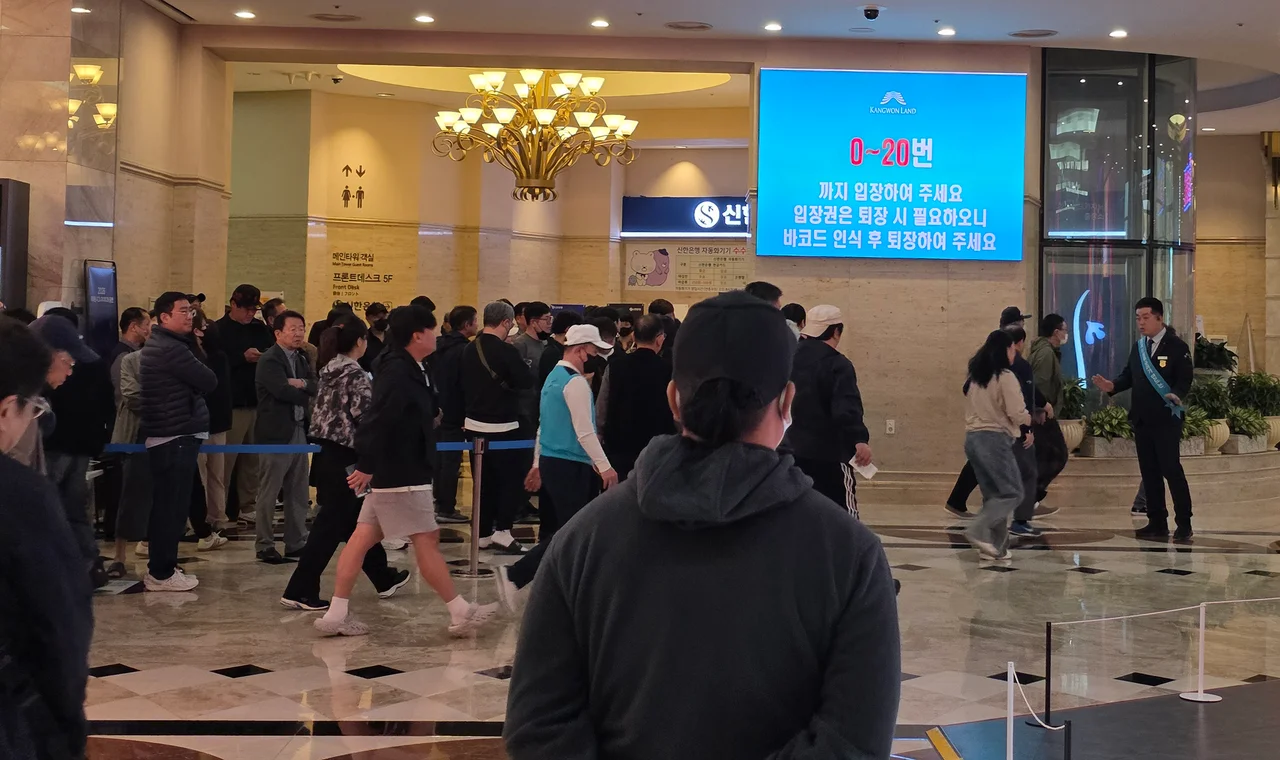
Every day at 6 AM, the closing announcement echoes through the brightly lit floor of the Kangwon Land Casino.
Customers enjoying their games are forced to leave, as the facility reopens just four hours later at 10 AM.
At that time, a different scene unfolds at the casino entrance: a competition between customers waiting for their turn and those rushing to secure seats for popular games.
Although Kangwon Land, the only casino in South Korea open to locals, has celebrated its 26th anniversary, the unique operational system of 20-hour days continues to create the same recurring scenes.
While there is a justification for regulations aimed at preventing gambling addiction and fostering a healthy gaming culture, it is time to reconsider whether these operating hour restrictions are actually exacerbating customer congestion, causing inconvenience, and undermining the casino's competitiveness.
In particular, with the upcoming 2030 opening of the Osaka Integrated Resort (IR) in Japan, the issue of 24-hour operation is emerging as a new point of contention where customer service improvements, local economic interests, and responsible gaming policies collide.
◆ The History of 20-Hour Operations: A Casino Clock Created by Regulation
Kangwon Land Casino operates for 20 hours a day, from 10 AM to 6 AM the following day.
In 2018, the operating hours were reduced to 18 hours as part of the Ministry of Culture, Sports and Tourism's re-licensing conditions. This was a measure implemented alongside a reduction of 20 gaming tables as part of a policy to promote sound gambling industries.
However, backlash from the local commercial sector followed, and after adjustments to operating hours and changes to re-licensing conditions, the system returned to a 20-hour schedule in 2020.
To this day, the operational method of closing for 4 hours a day is maintained.
The problem is that restricting casino operating hours does not necessarily reduce the visitors' desire to play or demand for visits at the same rate.
Instead, it may fuel waiting times, congestion, and competition for seats as customers concentrate within the limited time and facilities.
This is why objective verification is needed on how effective reducing operating hours is in actually preventing gambling addiction and what impact it has on customers' gaming habits.
◆ The 10 AM 'Entry War': Inconvenience Waits Before the Customers
At Kangwon Land Casino, the entry process itself is a significant burden for customers.
Customers must go through procedures such as ARS pre-booking, checking entry numbers, and waiting on-site, and even after successfully entering, they cannot immediately use their desired games.
In particular, it is not uncommon to see customers wandering around or waiting for long periods because they could not secure a seat at popular slot machines or table games.
Conversely, there is an imbalance in facility usage, with some less-preferred game machines seeing relatively low utilization.
When operating hours are restricted and popular game seats are scarce, customers inevitably feel more frustrated by waiting than by playing.
This structure also creates an environment that can lead to illegal or irregular activities such as seat trading, proxy betting, and preemptive seat holding.
While one cannot conclude that the 20-hour regulation is the sole direct cause of these problems, it is clear that the combination of limited hours, insufficient popular gaming facilities, and complex entry procedures is a structure that aggravates customer inconvenience.
◆ The Paradox of Gambling Addiction Prevention: Does Closing for 4 Hours Solve It?
The primary reason the government restricts casino operating hours is to prevent gambling addiction.
Due to the nature of casinos, long hours of play can lead to fatigue, impaired judgment, and excessive spending.
Therefore, the policy intent of interrupting continuous play through a set closing time is understandable.
However, it is a separate issue whether a uniform restriction applied to all customers actually reduces over-immersion for high-risk users.
For instance, it is questionable whether a 4-hour closure is enough to guarantee sufficient rest and recovery for a customer who spends 20 hours a day immersed in gaming.
Conversely, there is the issue that even casual visitors are subject to the same restrictions, enduring wait times and limited access.
Kangwon Land operates various responsible gaming devices, such as monthly visit limits and cooling-off periods.
Now, it is necessary to evolve beyond a system that uniformly restricts the operating hours of the entire facility toward a preventive system that analyzes individual cumulative usage time, visit frequency, and risk signs.
Casino operating hours and an individual's gaming time should be distinguished.
Even if 24-hour operation is permitted, customers should not be left to play for 24 consecutive hours.
Rather, if individual usage caps, mandatory breaks, voluntary spending limits, and counseling/entry restrictions for high-risk customers are strengthened, both goals—expanding operating hours and preventing gambling addiction—can be pursued together.
◆ The 24-Hour Operation Controversy: Why Does the Local Commercial Sector Oppose It?
The local community's stance on 24-hour operation at Kangwon Land is also noteworthy.
According to Tatata Journal, it has been identified that some social group representatives in the Sabuk area recently conveyed their opposition to 24-hour casino operations to Kangwon Land management.
While customers are demanding expanded hours, conflicting positions are emerging within parts of the local community.
Concerns have been raised that if the casino operates 24 hours a day, customers might stay inside the casino instead of using local accommodations or restaurants, potentially changing the business environment for local shops.
However, the exact positions of the opposing groups, their reasons, and the opinion of the entire local commercial district require further confirmation.
A notable point is the local community's reaction when hours were reduced in the past.
When Kangwon Land reduced operating hours to 18 hours in 2018, local merchants demanded a change back to a 6 AM closing time the following year, arguing that a 4 AM closing time was shrinking the local economy.
At that time, Kangwon Land decided to maintain the 18-hour total while delaying the opening time to noon and adjusting the closing time to 6 AM.
It is worth noting that the same local community that once demanded a later closing time is now voicing opposition to 24-hour operations.
Ultimately, casino operating hours affect not only customers but also local lodging, food businesses, transportation, and tourism consumption.
Therefore, an objective analysis must first be conducted to determine whether 24-hour operation actually reduces local revenue or creates new tourism consumption through increased stays.
It is pointed out that policy decisions for local coexistence should not be swayed by the arguments of a few stakeholders rather than objective data.
◆ 2030 Osaka IR: Casino Competition Won't Wait
The issue of Kangwon Land's operating hours goes beyond a simple debate over customer convenience; it is directly linked to international competitiveness.
The Osaka IR in Japan, aiming for an autumn 2030 opening, aspires to be a world-class integrated resort featuring large-scale casinos, hotels, international conference/exhibition facilities, and shopping/performance venues.
In a survey released by the Korea Casino Association on the 14th, 52.1% of 493 Kangwon Land customers expressed an intention to visit the Osaka IR.
In particular, 38.4% of respondents cited 'free casino gaming' as the reason for visiting Osaka, and 20.7% chose 'freedom of entry and regulation.'
As for areas needing improvement at Kangwon Land, service improvements (19.7%), expansion of auxiliary facilities (15.8%), 24-hour operation (15.1%), and increasing betting limits (13.6%) were cited in order.
This survey result suggests that operating hours and regulatory issues can influence customers' choices for overseas casinos.
However, 24-hour operation alone cannot prevent customer churn.
Comprehensive competitiveness, including the diversity of game types, seat availability, customer service, lodging/tourism facilities, and accessibility, must be supported.
Even if Kangwon Land maintains its monopoly as the only domestic casino for locals, it cannot restrict customers' choices for overseas casinos.
There is concern that if the timing for regulatory improvement is missed, it may be difficult to win back customers even after investing more capital after 2030.
◆ Staff Working Conditions and Customer Safety: Another Task for 24-Hour Operation
If the transition to 24-hour operation becomes a reality, the working conditions and safety of casino staff are also critical tasks.
Casino dealers, machine operators, security, currency exchange, and customer service staff are already burdened with shift work, emotional labor, and customer complaints.
If operating hours are expanded without corresponding increases in staffing or improvements to work systems, staff fatigue and industrial safety problems could worsen.
Therefore, discussing 24-hour operation must also include considerations for securing adequate personnel, redesigning shift schedules, guaranteeing regular breaks, and establishing nighttime emergency medical and security response systems.
Also, the methods for replacing tasks currently performed during closing hours—such as game facility maintenance, cleaning, and security checks—must be examined.
The prerequisite is to establish an operational system that protects the health and safety of employees while enhancing customer choice and convenience.
◆ President Kim Do-kyun's Test: Will the '20-Hour Shadow' Be Lifted?
The large-scale K-HIT project that Kangwon Land is promoting until 2032 focuses on a second casino floor, expansion of gaming facilities, and hotel/condo renovations.
However, even if massive facility investment is made, there will be limits to strengthening competitiveness if operating hours, customer usage environments, and regulatory systems remain in the past.
President Kim Do-kyun, who took office last September, faces the task of comprehensively coordinating customer convenience, responsible gaming, staff working conditions, and local community interests.
Most importantly, what is needed is an objective verification of the economic effects and social costs of 24-hour operation.
By comparing the current 20-hour operation with 24-hour operation, a comprehensive analysis of ▲customer wait times, ▲actual gaming time, ▲gambling addiction risks, ▲local commercial revenue, and ▲labor and safety management costs must be conducted.
The government also needs to re-examine whether controlling casinos solely through operating hours is effective.
24-hour operation is not necessarily the only answer. However, there is also insufficient evidence that the current 20-hour operation is the best.
What matters is not how much operating hours are extended, but how safely and conveniently customers can use the casino, and whether the local community and the company can achieve sustainable development in the process.
It is time for an empirical evaluation of whether Kangwon Land's 4-hour closure is a safety device to prevent gambling addiction or an outdated regulation that repeats customer inconvenience and congestion.
As Kangwon Land marks its 26th year, it is time to properly examine the '20-hour shadow' to prepare for the global competitive era of 2030.