The police are relaunching a voluntary reporting system to address the issues of youth cyber gambling and drug use. The initiative aims to identify youths exposed to addiction risks early and support their return to daily life through counseling and treatment rather than immediate punishment.
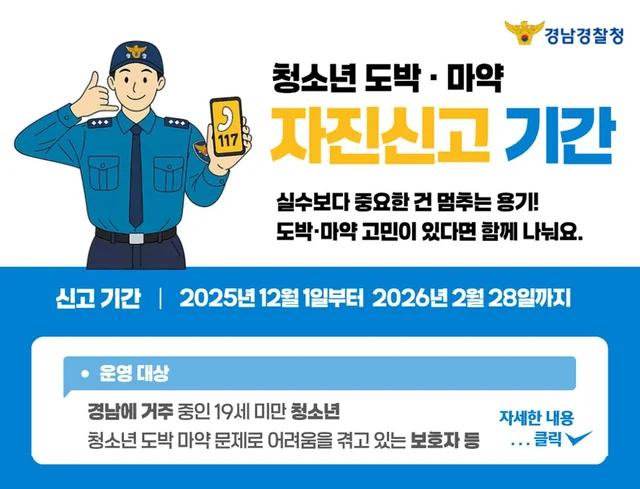
According to the National Police Agency on the 3rd, a 'Voluntary Reporting Period for Youth Addictive Crimes' will be in effect for one month, from the 16th of this month to December 15th.
Eligible for reporting are youths under 19 with experience in cyber gambling or drug use, as well as their guardians. In principle, reports should be made through the 117 School Violence Reporting and Counseling Center.
This measure follows the nationwide voluntary reporting system for youth cyber gambling that was implemented from May 18th to August 31st. During that period, 1,777 youths came forward voluntarily and were linked to healing support services.
This time, the police have expanded the scope to include drugs alongside cyber gambling to ensure early intervention for addictive crimes.
Once a voluntary report is received, School Resource Officers (SROs) and professional counselors will conduct initial consultations and assessments. For drug-related reports, investigators will also participate. Depending on the results, individuals will be connected to specialized programs at institutions such as the Korea Center on Gambling Problems and Prevention.
Regarding disciplinary actions, the police will consider the severity of the case and the potential for recovery rather than applying uniform criminal punishment.
The police plan to review factors such as the gambling amount, the seriousness of the violation, the level of remorse, and participation in treatment. Following a review by an external 'Guidance Deliberation Committee,' they will consider leniency, such as admonition or summary judgment.
However, voluntary reporting does not grant immunity for all illegal acts. Depending on the gravity of the crime, criminal proceedings may still be initiated.
Even after the initial disposition, the police plan to provide follow-up care involving SROs and professional counselors to support recidivism prevention and a successful return to daily life.
The issue of youth cyber gambling is particularly concerning as it often extends beyond simple curiosity or one-time gaming.
Illegal online casinos are easily accessible via smartphones and offer various games like slots and baccarat. There is also a risk that youths may be exposed to illegal private lending (such as 'proxy deposits') to fund their gambling, or become involved in secondary crimes like fraud or theft.
The government's decision to combine voluntary reporting with treatment support reflects the recognition that youth gambling is an addiction problem requiring early intervention, not just a simple act of delinquency.
However, experts point out that for the system to be effective, there must be continuous monitoring to ensure that professional counseling and treatment actually follow the reports and that long-term management systems are in place to prevent re-gambling.
Additionally, tasks such as cracking down on illegal online casino sites easily accessed by youths, blocking advertisements, and providing preventive education in schools and homes remain essential.
A comprehensive response is required to cut off the supply chains luring youths into illegal gambling while simultaneously providing recovery opportunities for those already exposed.