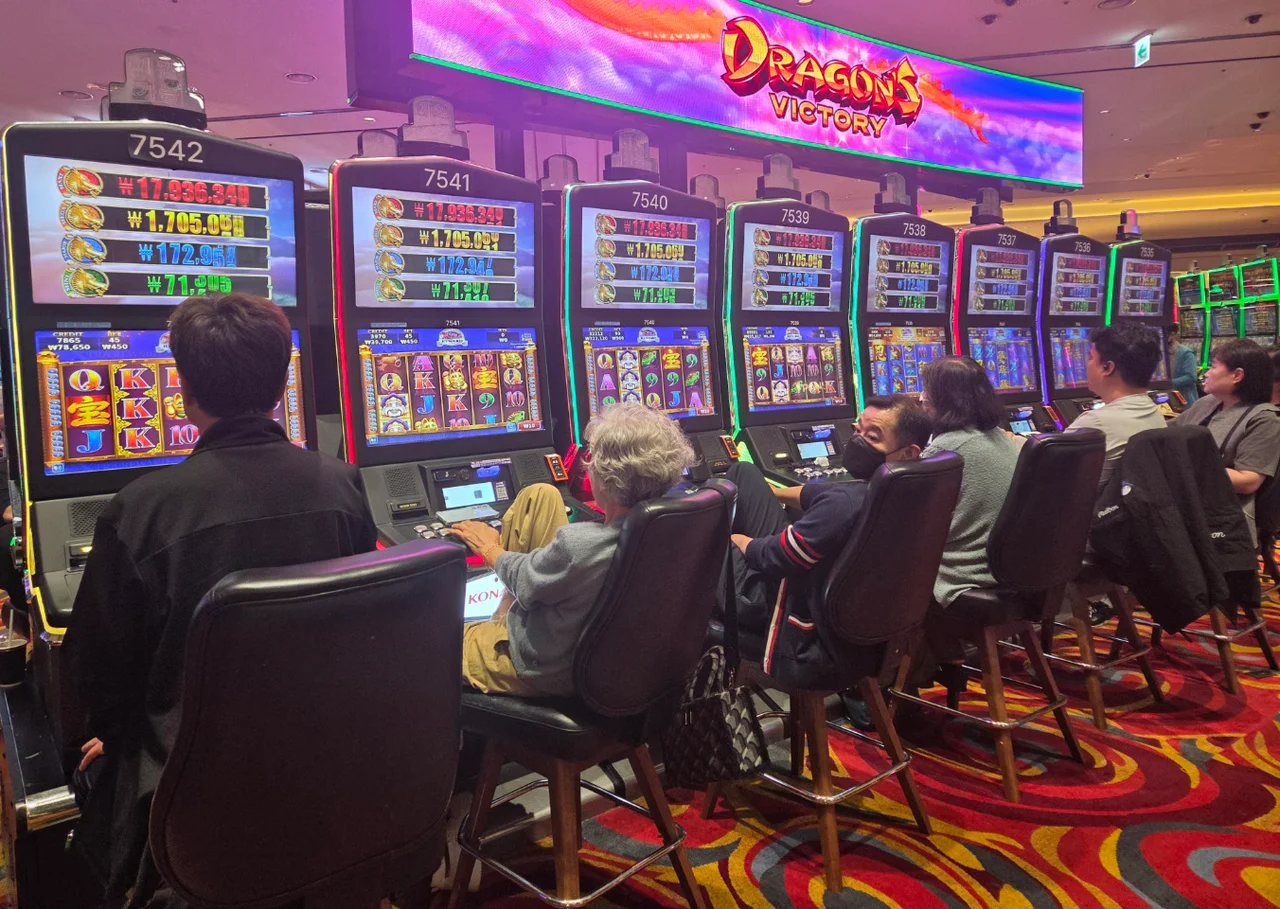
To enjoy a game at the casino, you must first 'play a game.' And no, it’s not slots or baccarat. It’s a different kind of game: securing your place in the entry queue, grabbing the seat you want, and fighting to keep it.
This is the unique scene that unfolds at Kangwon Land, the only casino in South Korea where locals are permitted to enter.
Some wait for opening hours just to claim a popular slot machine, while others wander the floor unable to access the games they want. Some customers are even hesitant to go for a meal for fear of losing the seat they worked so hard to secure.
There have even been issues with unofficial transactions where people sell seats at popular machines for money.
In essence, the competition to secure a seat takes precedence over the actual outcome of the games.
This landscape cannot be explained simply by the personalities or behaviors of the customers.
It is the result of a complex interplay over the past 26 years: a monopoly as the only domestic casino, government regulations, a shortage of gaming facilities, long-distance travel, and the negative social stigma surrounding gambling. This has formed a unique casino usage culture.
This is the light and shadow of the so-called 'Korean-style casino culture' created by Kangwon Land.
◆ Not a Casino Trip, but an 'Expedition'... Exhausted from the Start
Major global casino destinations like Las Vegas, Macau, and Singapore have developed into integrated resort industries that combine hotels, performances, shopping, fine dining, and leisure.
Of course, overseas casinos also face side effects such as gambling addiction, long-term stays, and disputes between customers.
However, Kangwon Land was different from the start.
It is a special enterprise established for the national task of economic revitalization and job creation in abandoned mining areas, rather than for the promotion of the casino industry itself.
In particular, the fact that there is only one casino where locals can legally enter has changed how customers visit.
Customers travel for long hours from all over the country—not just the capital region, but also the Gyeongsang and Jeolla provinces—to reach this casino in the mountains of Gangwon-do.
It has become an 'expedition-style casino' where people invest not just time, but also travel and accommodation expenses, rather than a casual leisure activity in a nearby city.
The problem is that customers who have traveled a long way feel pressured to enjoy the games as much as possible within a limited time.
"I can't just go back after coming all this way."
When this mindset combines with the desire to recover losses, it creates a risk of excessive betting or prolonged gameplay.
While this doesn't apply to every customer, the potential for long-distance travel and a restricted gaming environment to increase psychological burden needs to be addressed.
◆ 'Seat Wars' More Frightening Than the Games... A Casino Within a Casino
Kangwon Land Casino operates 20 hours a day with 200 gaming tables and 1,360 slot machines.
The issue is not just the number of facilities, but the fact that demand is concentrated on specific slot machines and table games preferred by customers.
In an online survey conducted by Tatata Journal for its inaugural special report, some of the 1,300 participants pointed out the shortage of popular slot machines and the issue of seat preemption.
One customer requested, "Please crack down on people who put money in popular machines and play two at once."
Another customer expressed frustration, saying, "Staff seem to turn a blind eye even when people are selling seats at popular machines."
While the actual scale of seat trading or whether staff are complicit requires further investigation, the complaint that customers who follow normal entry procedures cannot access their desired games is significant.
In a casino, game results are determined by probability, but at Kangwon Land, some customers feel that the very opportunity to play is determined by who gets to the seat first.
The act of securing a seat at a popular machine has become a game in itself.
This is a representative paradox of the Korean-style casino culture created by monopoly and supply shortages.
◆ Regulars vs. Beginners, Information vs. Connections... The Invisible Hierarchy
Kangwon Land attracts a diverse crowd, from occasional beginners to regulars who have been visiting for decades.
Some customers are well-versed in specific games, the locations of popular machines, jackpot trends, and entry procedures.
Naturally, a gap in information and experience emerges among customers.
Long-term customers know the busy hours, the locations of popular games, and how to use them, while beginners often struggle from entry to game selection.
Some even judge the winning flow or jackpot potential of a machine based on their own 'experience' and share this information.
However, past winning results cannot predict the outcome of the next game.
Nevertheless, some customers feel that unofficial information and connections provide an advantage in securing seats or choosing games.
In particular, when this gap combines with unfair practices like seat trading or proxy betting, the normal order of gaming can be undermined.
What a casino needs is not implicit rules understood only by a few regulars, but an operating system that anyone can easily understand and use fairly.
◆ Do Even Ordinary People Change in the Casino?
One of the unique landscapes encountered while covering Kangwon Land for a long time is the diverse human behavior revealed inside the casino.
People who are polite and rational in society can become sensitive to small things or get into arguments over seats with other customers inside the casino.
Conversely, there are regulars who finish their games calmly even after losing large sums of money or show consideration for those around them.
This is why casino users cannot be categorized into a single type.
Behind the atypical behavior of some customers, factors like fatigue from long-distance travel, competition for seats, anxiety over losses, and sleep deprivation may all be at play.
In particular, when opportunities to use popular games are limited and wait times increase, even minor conflicts can escalate.
However, this does not justify being rude to staff or failing to show consideration for other customers.
At the same time, dismissing problematic customer behavior solely as a character flaw is not a sufficient explanation.
We must examine how much the casino's operating environment increases customer tension and discomfort.
The responsibility of the customer who causes trouble and the responsibility of the operator to improve an environment prone to such problems should be distinguished, but addressed together.
◆ Hiding the Fact of Visiting... The Dual Perspective of Korean Society
Another characteristic of the Korean-style casino culture is the social gaze.
While people talk naturally about trips to Las Vegas or Singapore, some customers are reluctant to let family or acquaintances know they have visited Kangwon Land.
This is due to the perception that views visiting a casino negatively.
Of course, negative views on gambling exist overseas as well, and many people in Korea talk openly about visiting casinos.
Nevertheless, for some customers, the casino remains a space that is more burdensome to explain to others than a pleasant tourist experience.
This perception can also influence how casino customers are treated.
In the Tatata Journal survey, some customers complained that staff and local merchants seem to treat them more like gambling addicts or one-time consumers than normal tourists.
One customer emphasized, "The people who come here are also someone's parents or children. We are not suckers."
While we should not blindly glorify casino usage as a wholesome leisure activity, we must also guard against labeling all visitors as problem users.
A culture that respects both the rights of customers enjoying legal leisure and the social boundaries against gambling addiction is necessary.
◆ Tension Created by Regulation... The 'Shadow of 20 Hours'
Kangwon Land is subject to various regulations, including a 20-hour daily operation limit, monthly entry limits, betting caps, and an ARS entry procedure.
These are systems designed to prevent gambling addiction and maintain order in casino usage.
However, it is necessary to examine how these regulations affect the actual usage behavior of customers.
Some customers argued that because of the monthly entry limits, they end up playing for as long as possible once they visit.
Others suggested a 'total time management system' that manages individual usage time rather than the number of visit days.
This is not just a demand for deregulation, but a voice calling for more effective responsible gaming policies.
In particular, the complaint that it is difficult to reuse a popular machine if one leaves the seat for a meal or rest is paradoxical.
While proper rest is necessary to prevent gambling addiction, the reality is that a situation arises where people hesitate to even eat for fear of losing their seat.
Casino operating hours and individual customer gaming time should be distinguished.
Responsible gaming policies also need to evolve beyond simple entry restrictions to managing usage time, spending, and risk indicators together.
◆ The Casino Has Grown, but the Joy of Travel is Lacking
Kangwon Land operates various tourist facilities, including hotels, condos, ski resorts, golf courses, and a water world, in addition to the casino.
However, looking at the purpose of visits and usage patterns of casino customers, critics point out that it has not sufficiently moved away from a game-centric structure.
The mere existence of non-casino facilities does not automatically mean customers enjoy tourism and relaxation.
There must be experiential content such as performances, culture, shopping, food, and night tourism that customers can enjoy even outside the casino.
If customers could enjoy performances, delicious food, and relaxation even if they lost money at the casino, their memories of the trip would be different.
The same applies to the local commercial area.
Customer complaints about the price, hygiene, and service of food and lodging in the Gohan and Sabuk areas are linked to Kangwon Land's tourism competitiveness.
If the casino and the surrounding area do not function as a single tourist destination, there is a limit to how much facility investment alone can increase customer satisfaction.
◆ Monopoly-Created Casino Culture... It's Time for a Change
The achievements Kangwon Land has made over the past 26 years are by no means small.
It has played a significant role in jobs for abandoned mining areas, local taxes, the abandoned mine fund, and the development of the tourism industry, while also fulfilling public responsibilities such as preventing gambling addiction.
The problem is that there is no need to maintain the side effects created by a monopolistic business structure moving forward.
Entry competition, lack of popular machines, seat trading, conflict between customers and staff, distrust of games, and lack of tourism content should not be accepted as the 'natural' casino landscape.
We must improve supply and operating systems so that customers can fairly access the games they want, and ensure that staff can provide professional services in a safe and respected environment.
Furthermore, we must create an environment where dining, rest, and tourism can be enjoyed naturally and enhance service competitiveness together with the local community.
Regulations should also evolve into rational methods that fit the actual usage behavior of customers while maintaining the goal of preventing gambling addiction.
Above all, we need to change the perception that views casino customers merely as a source of revenue or subjects to be controlled.
For the past 26 years, Kangwon Land has been a casino that customers had no choice but to visit. However, in the future, it must become a casino that customers want to visit again of their own volition.
This means shifting from an era where monopoly brought in customers to an era where service and experience drive customer choice.
The future of Kangwon Land is not determined solely by the scale of the casino or the number of gaming machines.
Seo Cheon-beom, head of the Korea Leisure Industry Institute, said, "Ahead of the 2030 opening of the Osaka IR in Japan, it depends on whether we can reduce the tension and competition that starts before entering the casino, and whether we can leave customers with the memory of having been treated fairly regardless of the win or loss after enjoying the game. This is the true competitiveness of Kangwon Land."
You can lose money at a casino. However, you should not lose your dignity, trust, rest, and freedom of choice at a place you visited to have a good time.
While the casino cannot guarantee the outcome of a game, it must take responsibility for fair opportunities and a respected experience.
It is time to change the Korean-style casino culture created by a monopoly into a new tourism culture where customers, staff, and the local community are all respected.