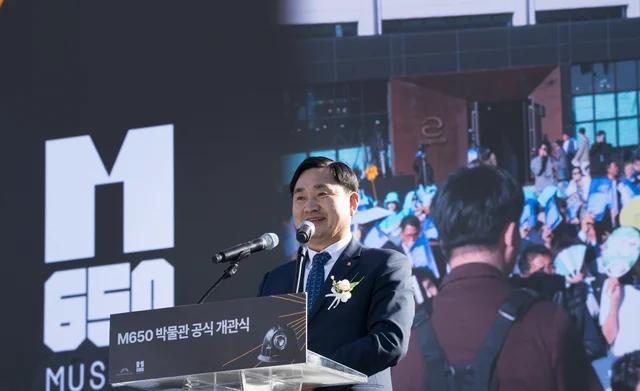
Kangwon Land CEO Kim Do-kyun, who took office on September 2, will undergo his first parliamentary audit since his appointment on the 19th. This session is expected to be a stage for verifying his background as a former military general and ruling party politician, as well as for detailing his management vision, including organizational and HR innovation, the K-HIT project, regional cooperation, and customer service improvements.
According to the audit schedule released by the National Assembly's Trade, Industry, Energy, SMEs and Startups Committee on the 16th, the audit will take place at the Korea Gas Corporation in Daegu. The audit covers eight institutions, including Kangwon Land, Korea National Oil Corporation, Korea Gas Corporation, Korea Coal Corporation, Korea Gas Technology Corporation, Korea Gas Safety Corporation, Korea Petroleum Quality & Distribution Authority, and the Mine Reclamation Corporation.
CEO Kim previously served as the Commander of the Capital Defense Command and as the Democratic Party's regional committee chair for Sokcho, Inje, Goseong, and Yangyang, as well as the Gangwon Provincial Party chair. He ran as a Democratic Party candidate for the same district in the 2024 22nd General Election but was unsuccessful.
Given this background, opposition party lawmakers are likely to question his expertise in the casino, hotel, and resort sectors, as well as the appropriateness of his appointment. Questions regarding his intentions for future elections and the continuity of his management during his term are also anticipated.
In his inaugural address, CEO Kim outlined his management direction: transforming into a complex resort that pursues both profitability and public interest, building a cooperative system to support the local economy, and improving organizational culture based on communication and fairness. He also set regulatory reform and strengthening addiction prevention systems using AI as key tasks.
During this audit, a key point of verification will be how he intends to execute these directions in terms of organization, personnel, and budget.
Kangwon Land established an 8-member 'Organizational Diagnosis and Innovation TF,' including team leader Kim Dae-jeong, on the 22nd of last month. On the 2nd of this month, it launched an 'Organizational Diagnosis and Innovation Committee' involving internal and external figures.
By the end of the year, the committee will review and prepare improvement plans for organizational and HR systems, major policy tasks like K-HIT, and organizational culture and work methods. The structure also incorporates feedback from labor unions, on-site workers, and female and young employees.
Future personnel directions following the organizational diagnosis are also a point of interest. Expected questions include how he will leverage expertise in casino and resort operations and how he will establish HR principles based on performance and capability. Specifics regarding the scale, timing, and criteria for personnel appointments remain to be seen.
Whether the reorganization reduces reporting and approval stages, speeds up on-site problem-solving, and reflects employee opinions in decision-making will be key performance indicators. In particular, HR innovation is crucial for securing employee trust through fair evaluation and predictable position management.
The K-HIT project is a task that requires explaining both the execution capability of the investment plan and the direction of its supplementation.
In a master plan announced last November, Kangwon Land proposed investing approximately 3 trillion won by 2035 to expand entertainment, lodging, casino, and wellness/leisure facilities.
Consequently, questions are expected regarding how the business feasibility and investment priorities of existing plans are being reviewed, and what measures are in place to respond to rising construction costs and changes in tourism demand. Explanations regarding opening schedules for each facility, return on investment forecasts, and profitability improvement goals for non-casino sectors are also required.
As CEO Kim has been in office for less than two months, it is difficult to hold the new management solely responsible for the achievements and limitations of existing projects. However, the current management must present what to maintain or supplement from previous plans and how to manage risks such as project delays and cost increases.
The second casino venue is also a matter to be reviewed, including preparation schedules, operating costs, staffing, and convenience of movement from the existing venue. The core issue is whether facility expansion leads to game configurations that meet customer demand and improvements in the usage environment.
Customer service innovation is an immediate task that must be pursued alongside long-term investment projects.
Expected questions involve the order of improvements for issues like entrance and seating inconveniences, responses to demand for preferred games, rest areas and convenience facilities, and complaint handling. The effectiveness of service innovation can only be evaluated if there is a system in place that collects customer feedback, sets deadlines for processing, and discloses improvement results.
Plans for strengthening competitiveness should comprehensively examine content, accessibility, and service quality alongside facility scale. Products to attract family tourists and overseas visitors, programs to encourage year-round stays, and circulation paths connecting casino and non-casino facilities are all subject to inspection.
In terms of regional cooperation, beyond the scale of support, it is important to prove the employment and income generated for the region.
Sustainable management is the standard for managing these tasks together. It is necessary to establish a management structure that maintains financial capacity for large-scale investments while reducing reliance on the casino and ensuring continued customer protection and contributions to the local community.
In particular, if pushing for regulatory reform, devices to prevent excessive gambling must also be explained. Expected queries include systems to identify risk signs in long-term/repeat visitors and elderly customers, connecting them to counseling and usage control, as well as personal information protection and effectiveness verification in the process of using AI.
A safe workplace and facility operation, transparent budget execution, and fair personnel management are also basic conditions supporting sustainability. Moving beyond presenting organizational innovation, investment projects, and customer protection as mere slogans, an execution plan connecting goals, schedules, and responsible departments is required.
With the 26th anniversary of the casino opening approaching on the 28th, Kangwon Land faces the tasks of finding new growth engines and reviving the local economy. In CEO Kim's first parliamentary audit, how he responds to questions about his political career and how concretely he has turned his management vision into actionable plans will be the main evaluation criteria.