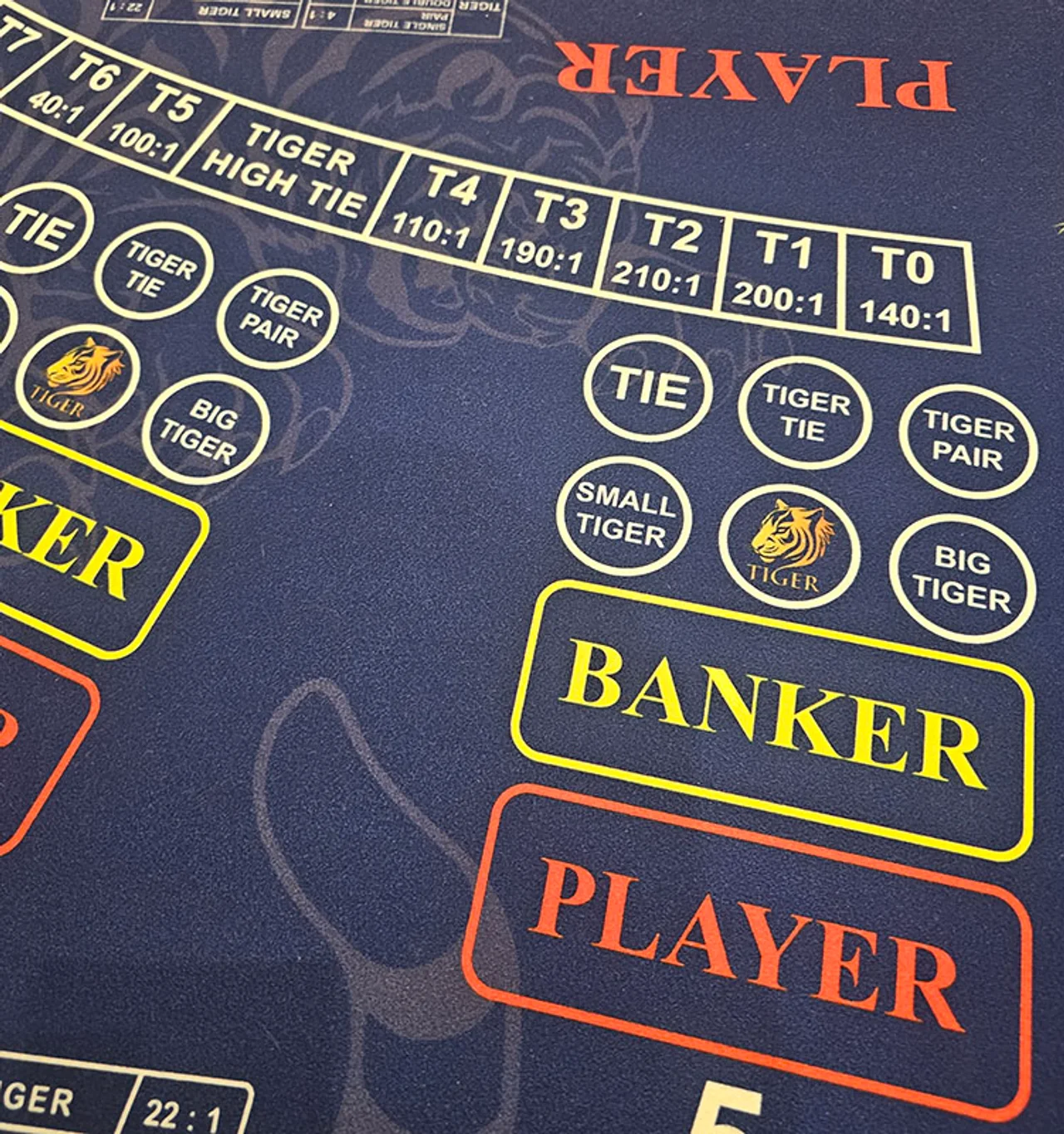

Since the Kangwon Land Casino opened in 2000, I have met countless customers, dealers, and casino staff over the past 26 years. Everyone had different reasons for coming to the casino. Some wanted to cover travel expenses, others hoped to earn business capital or pay off debts. I even met people who claimed they could earn a living through 'lifestyle baccarat.'
Many customers came prepared. Some recorded baccarat results for years, analyzing the sequence of bankers and players. Others created their own formulas by noting the times and amounts of slot machine jackpots. Some learned betting methods from self-proclaimed experts or calculated exactly how much more to bet after a losing streak.
There are indeed days when you win big money. That is why the thought, 'I can keep winning with this method,' sounds so plausible. However, to see if that method truly made money, you shouldn't just boast about the amount won on a lucky day; you must first calculate the total amount wagered and subtract the losses from the days you didn't win.
◇ Even if you bring $1,000, your total bets can reach $10,000
The rules and payouts of casino games contain a mathematical advantage for the house, known as the 'house edge.' Simply put, it is the percentage of money a customer is expected to lose on average when repeating bets under the same conditions.
For example, in standard baccarat using 8 decks, if the rule is to pay a 5% commission on banker wins, the house edge is approximately 1.06% for the banker and 1.24% for the player. For a tie bet with an 8-to-1 payout, it is about 14.36%. Even at the same baccarat table, the average loss rate varies significantly depending on the type of bet. These figures are calculated based on specific rules and payouts.
Let's imagine a hypothetical game with a 1% house edge. You enter with $1,000 and bet $100 at a time. If you play 100 hands, including re-betting your winnings, your total betting volume for the day is $10,000. Applying the 1% edge, your expected loss is $100. Some days you might leave with a profit, and other days you might lose your entire bankroll early. The $100 is the average when many such sessions of $10,000 in total bets are aggregated.
Under the same conditions, if you play 10 hands of $100, the total bet is $1,000 and the expected loss is $10. If you play 100 hands, both figures increase tenfold. The longer you stay on the floor and the more hands you play, the more your money is exposed to the casino's advantage. Even if you don't buy new chips, every time you re-bet the same chips, that amount is added to your total betting volume.
◇ If the banker has appeared six times, what about the seventh?
At Kangwon Land baccarat tables, customers' eyes are glued to the electronic display. Some believe that if the banker appears six times in a row, it's time to ride the 'long streak.' Others look at the same screen and decide it's time for the player to win. When the banker and player alternate, it's called 'ping-pong,' and some try to 'break' the flow when they sense a change.
'Long streak' and 'ping-pong' are just names given to past results. The record of six banker wins explains those six hands. The reason two people can look at the same screen and reach opposite conclusions about the seventh hand lies right there.
In baccarat using physical cards, the composition of the remaining deck changes with every card dealt. It is inaccurate to say the probability of every hand is identical. However, it is difficult to know the remaining card composition just by looking at the win/loss array on the display. There is insufficient evidence to consistently predict the next hand based solely on that array.
The belief that 'I've lost six times, so it's my turn to win' is called the 'gambler's fallacy.' It is easy to feel that the more you lose in previous hands, the greater your chance of winning it back in the next. The moment you bet more than usual based on that belief, the only thing that definitely changes is the amount you stand to lose on that hand.
◇ Martingale: Starting at $100, eight losses lead to $25,500
Martingale is a method of doubling your bet after every loss. In a game where winning nets you your bet amount, if you lose $100 on the first hand and bet $200 on the second and win, you recover your loss and have $100 left. It seems easy to recover losses by calculating just two or three hands. But if you open the ledger after a long losing streak, the story changes.
Your first bet is $100, but after 8 consecutive losses, you have already lost $25,500 and need $25,600 for the next bet. If you lose that hand, your loss is $51,100. This table is a hypothetical calculation showing how fast the amount grows. In an actual casino, you would likely be unable to continue doubling due to your bankroll limit or the table's betting cap.
Commissions also change the math. Suppose you lost $25,500 and bet $25,600 on the next hand. If the victory commission is 5%, your net profit from winning that hand is $24,320. Even if you win, your cumulative profit/loss is still a deficit of $1,180. Using Martingale changes the size of your bets based on wins and losses, but the casino's favorable payout structure remains in effect.
◇ The missing number in '80% win rate'
Let's say a hypothetical customer visits the casino ten times. They win $100 eight times and lose $500 twice. Since they won eight out of ten times, their visit-based win rate is 80%. However, the money won is $800, and the money lost is $1,000. Combined, they are at a $200 deficit.
Even the claim of 'winning $5,000 in a day' reads differently when you look at the days before and after. If you lost $10,000 the day before, your net profit/loss for the two days is a $5,000 loss. If you add travel expenses, accommodation, and food costs to Jeongseon, the actual expenditure is even higher.
If someone recommends a 'winning system' and shows you a photo of their winnings, you must look at how much they bet to get that photo. It is also important to know what their total profit or loss was for the month or year, and how much they lost on their worst day. It is difficult to judge a person's profitability based on records that only show the days they won.
◇ 'The person before me lost a lot, so it's bound to hit now'
In front of slot machines at Kangwon Land, you often hear, 'A lot of money has gone into this machine,' or 'It hasn't hit a jackpot in a while, so it's time.' Some even think that if the person before them sat there for a long time and left empty-handed, that seat looks more favorable.
In standard independent random number generator (RNG) slot machines, the previous player's losses or the results of previous spins do not increase the probability of winning on the next spin. The machine is not structured to 'pay back' the money the previous player lost to the next customer.
Jackpot and bonus rules vary by model. There are progressive jackpots where a portion of bets from multiple machines accumulates, and games that offer rewards under specific conditions. What you must distinguish is the size of the jackpot shown on the screen and the conditions for receiving that reward. The fact that the jackpot number has grown does not mean the probability of winning on the next spin has increased. You must check the instructions for each machine to see the conditions for rewards.
◇ Casino experts exist. Proving long-term profit is a different matter
There are skilled players who understand the rules and probabilities of the game. In blackjack, learning basic strategy can reduce errors in decision-making and lower the casino's advantage. In some special conditions, analyzing the remaining card composition can provide a mathematical edge. In poker, where you compete against other participants, the ability to read opponents and calculate probabilities affects your performance.
However, to turn such an edge into actual net profit, you must consider the game rules, operating conditions, commissions, and the capital to withstand losing streaks. Even in poker, just being better than your opponents doesn't guarantee profit. You must see if you remained profitable over the long term after paying entry fees and rake.
There is a gap between saying you have been going to the casino for a long time and proving your net profit over several years with a ledger. A nickname like 'pro gambler' or a single big win tells you less than a record that includes all losses and expenses.
◇ When you say, 'I'll just get my principal back and leave'
One of the most common things I heard on the floor was, 'I'll just win back the money I lost and quit.' For example, suppose you set a leisure budget of $300 and lost $200. According to your initial plan, your remaining spending limit is $100. But if you become obsessed with breaking even, the $200 you already lost looks bigger than the $100 you have left. If you raise your bet size to win that money back or head to the ATM, your initial budget is effectively destroyed.
If you use a casino, it is better to set a few standards before entering the floor:
Separate living expenses from gaming funds. Do not use rent, loan repayments, or family living expenses for gaming.
Set both the amount to spend and the time to leave. If you hit either limit, end the game for the day. Do not withdraw additional cash or borrow money from acquaintances to continue playing.
Record both winning and losing days. Calculate your monthly gaming profit/loss and add travel and accommodation costs to see how much you actually spent.
Leave the table or machine if you have been drinking or are exhausted. If you feel angry or impatient and want to increase your bets, step away immediately.
If you repeatedly visit to recover losses, seek counseling. If you find it difficult to leave at the set time or if your home or work life is suffering, take a break and request help from the Korea Center on Gambling Problems (1336).
◇ The operator must also help customers stop
For customers to stick to their limits, they must be aware of their usage time and spending. Operators should make that information easily accessible and ensure that payouts, commissions, and bonus conditions are understood before playing. Places to request a break or self-exclusion, as well as how to get counseling, should be easy to find on the floor. Operators should be able to connect customers who play for long hours or experience repeated large losses to counseling and prevention support.
Over 26 years at Kangwon Land, I have seen people walk away with big winnings, and I have seen people entrust their fate to records they kept for years. From that experience, there is one calculation I strongly recommend to readers: before counting the money you won today, write down the money you lost last month and the costs you incurred to get here.
There are days when you win at the casino. But your living expenses and debt repayment deadlines will not wait for your winning days. Leaving at the time you first decided and not opening your wallet again once you've spent the money you first set aside—this is the first thing I want to tell readers after watching the Kangwon Land floor for so long.