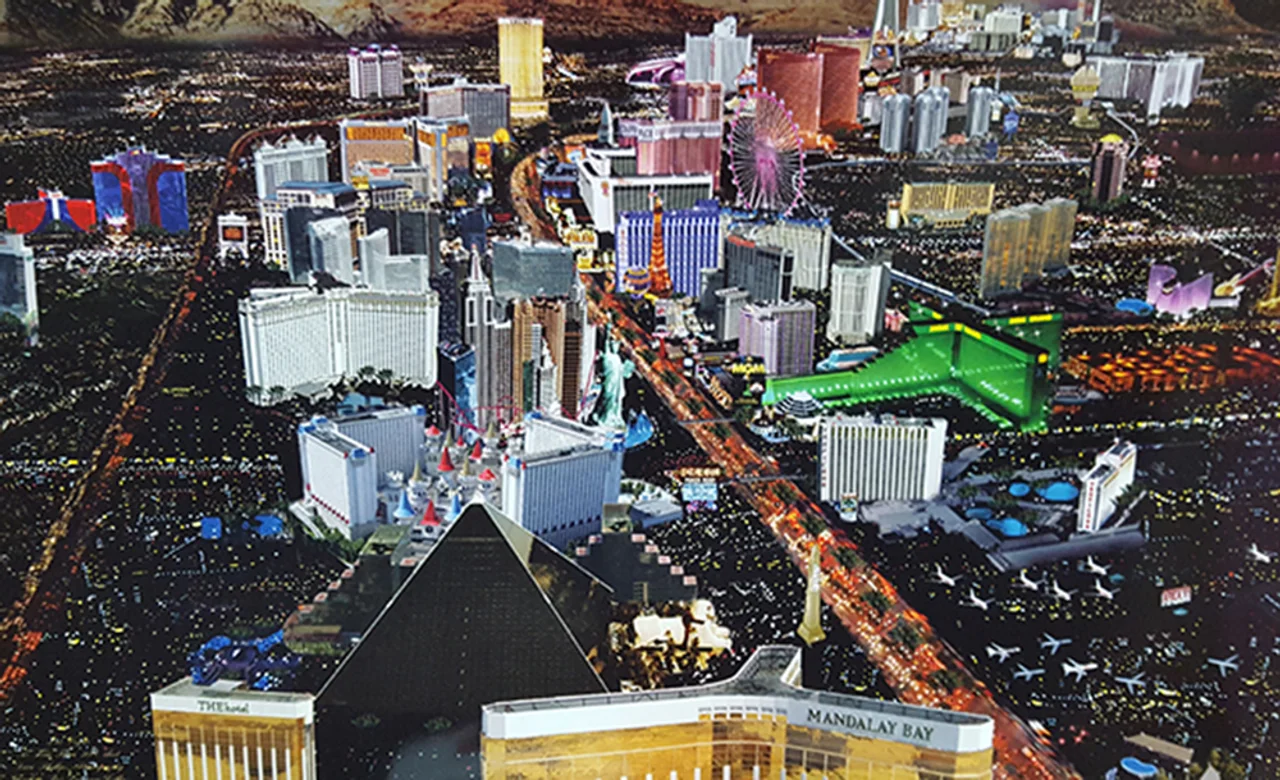

Las Vegas in the United States and Macau in China are the two cities that define the global casino industry.
Las Vegas grew from the middle of a desert into a world-class entertainment hub, while Macau leaped from a trading port where East and West cultures intersect to become the center of Asian casinos. Both cities are iconic examples of how casinos can reshape a city's destiny and industrial landscape.
According to the latest official statistics, the population of Las Vegas was 679,817 as of July 1, 2025, and Macau's total population was 686,500 as of the end of June 2026. While administrative districts and calculation standards differ, the population scale of the cities themselves is similar. If you expand the scope to the metropolitan area including surrounding cities, Las Vegas reaches approximately 2.41 million.
The tourism demand they attract far exceeds their resident populations. In 2025, Las Vegas recorded approximately 38.5 million visitors, while Macau recorded approximately 40.07 million. Although a simple ranking comparison is difficult due to different counting methods and tourism zones, both cities have established themselves as world-class travel destinations.
However, behind the facade of flashy casinos and large hotels lie different growth formulas. The question to understand the difference between the two cities is less about 'which is flashier' and more about 'who visits, why do they come, and is there a reason to stay outside the casino?'
◇ Desert City vs. Trading Port: Different from the Start
Turning points often cited in the growth of Las Vegas include the legalization of casinos in Nevada in 1931 and the construction of the Hoover Dam. The influx of workers and visitors increased demand for lodging and entertainment, and the subsequent combination of casino hotels and the performing arts industry formed the foundation of a tourist city.
While there were shadows of organized crime capital in the early days, the focus shifted to corporate capital and large resort operators, broadening the scope of competition. Beyond the size of the gaming floor, hotel rooms, restaurants, performances, shopping, and exhibition facilities became the means to attract customers.
Macau's major turning point was the transition from monopoly to competition.
The STDM-centered system that had existed since 1962 changed with the opening of the casino market in 2002. Macau government data also categorizes casino history into the traditional gaming era, the STDM monopoly era, and the integrated resort era after 2002.
Since then, as global casino capital entered and large integrated resorts were clustered in Cotai, the city's tourism landscape changed. Casino tourism, which was previously centered on the Macau Peninsula, expanded into resort tourism that consumes hotels, shopping, and performances together.
If Las Vegas accumulated reasons for visiting over a long period, Macau accelerated the speed of change through market opening and large-scale investment.
◇ The Power of Las Vegas: 'Diversity in Reasons to Visit'
In Las Vegas, you can fill your travel itinerary even without gambling. You can attend international exhibitions and corporate events, watch performances and sports games, and enjoy restaurants and shopping facilities.
This demand drives the city at different times and days of the week. Conventions create weekday lodging demand, while performances and sports attract tourists on specific dates. Even companions who do not use the casino have reasons to enjoy the trip.
The significance of this structure is revealed when tourism demand fluctuates.
According to the Las Vegas Convention and Visitors Authority, visitors in 2025 decreased by 7.5% compared to the previous year. However, convention attendees remained at approximately 6 million, similar to the previous year. The authority explained that convention activities played a role in supporting the tourism industry.
Industrial diversification does not prevent all crises. However, if there are multiple purposes for visiting, there is room to share the shock when specific demand decreases.
The competitiveness shown by Las Vegas is its operational ability to connect lodging, dining, performances, and events across the entire city, beyond the success of a single massive casino.
◇ The Power of Macau: 'Clustering and Hinterland Market'
Macau has large casinos, luxury hotels, shopping malls, restaurants, and performance facilities concentrated in a relatively small area. Tourists can compare and use various resorts, and operators compete in facilities and services to secure customers.
Its location adjacent to mainland China is also a powerful competitive edge. However, the fact that the customer base is concentrated in a specific region acts as a limitation at the same time.
Among Macau visitors in 2025, approximately 29.02 million were from mainland China, 7.3 million from Hong Kong, and 1 million from Taiwan. Visitors from these three regions accounted for about 93% of the total.
While a massive hinterland market is a driving force for growth, the impact of changes in that market's economy, entry/exit policies, and capital movement on the city's economy is also significant.
The decline of junket-centered operations, which previously attracted high-net-worth customers, shows this structural sensitivity. Junkets are intermediaries that connect customers to casinos. As this market has shrunk, the importance of customers secured directly by casino operators and mass-market customers has increased.
However, the decline of junkets should not be understood as the total disappearance of the VIP market. Rather than high-net-worth customers disappearing, one should look at how the methods of attracting and managing customers and the composition of the market are changing.
◇ Does More Tourists Mean a Wealthier City?
While the number of visitors is an important indicator for a tourist city, it is difficult to judge the performance of the industry based on that alone.
Among Macau's 2025 visitors, approximately 23.52 million were same-day visitors, accounting for about 59% of the total. Overnight visitors were approximately 16.54 million, and the average length of stay for all visitors was 1.1 days. It is known that most same-day visitors are residents of nearby Zhuhai visiting for employment.
Same-day visitors also contribute to the economy through dining and shopping. However, the range of tourism effects varies depending on whether they stay overnight, the length of stay, and the location of consumption. This is why one cannot conclude that hotel and local commercial district sales have improved just because the number of arrivals has increased.
Conversely, even if the number of visitors decreases, the performance of some luxury hotels or specific operators may improve. That does not mean the city as a whole is booming.
To understand the tourism industry, one must examine the effects that lead to local commercial districts, along with occupancy rates, length of stay, consumption scale, and operator profitability, in addition to the number of visitors.
◇ Casino Revenue Must Be Compared Using the Same Standards
The most common error when comparing Las Vegas and Macau is placing statistics of different scopes side by side.
The entire state of Nevada and the Las Vegas Strip are not the same area. The tourism zone that tourists usually call 'Las Vegas' does not exactly match the administrative district of the city of Las Vegas. One must remember these differences when presenting city population and tourism performance together.
The concept of revenue must also be distinguished.
GGR (Gross Gaming Revenue) generally refers to the amount remaining after subtracting winnings paid out to customers from the total amount bet by customers. It does not mean the total amount of money bet by customers or the net profit of the casino.
Total resort revenue, which adds revenue from rooms, food and beverage, shopping, and performances, is another indicator. The competitiveness of a city with high gaming revenue and a city with diverse tourism consumption needs to be evaluated in different ways.
◇ Neither City Is a 'Finished Product'
Las Vegas's challenge is providing diverse content at prices and experiences that customers find acceptable.
As luxury facilities increase, customer expectations also rise. If resort fees, parking fees, and food and beverage costs are added on top of room rates, the burden on travelers can increase. The luxury of facilities does not necessarily lead to customer satisfaction or repeat visits.
However, the 2025 decline in visitors should not be explained by price alone. The tourism authority presented economic uncertainty, travel trends, and changes in the policy environment together.
Macau's challenge is to diversify its customer market and tourism demand while maintaining its casino competitiveness.
At the time of signing the casino operating contracts for 2023–2032, the six operators promised a total investment of 118.8 billion patacas. Of this, 108.7 billion patacas were allocated to developing overseas customer markets and non-casino businesses. This is an investment commitment at the time of the contract and should be distinguished from the actual performance of full execution.
As important as the scale of investment is the operational outcome. Building a performance venue and consistently gathering audiences are different things. Exhibition halls need events, hotels need lodging demand, and shopping malls need purchasing customers.
The success of non-casino businesses should be judged by actual usage demand, profits, and contribution to the urban economy, rather than the size of the building.
◇ How to Read the Differences Between the Two Cities
Major Turning Point in Growth: Legalization of casinos and development of large resorts/performance industries vs. Transition from monopoly to competition.
Characteristics of Tourism Demand: Combination of visit purposes such as casinos, conventions, performances, and sports vs. Concentration of demand from mainland China, Hong Kong, and Taiwan.
Core Strengths: Operating a tourist city that connects various industries vs. Clustering of integrated resorts and a massive hinterland market.
Key Vulnerabilities: Travel cost burden and changes in economic/travel demand vs. Dependence on specific markets and the casino industry.
Future Challenges: Maintaining value-for-money satisfaction and visit demand vs. Diversification of customer markets and expansion of non-casino demand.
◇ What Kangwon Land Should Learn is 'Reasons to Visit' Over 'Size of Facilities'
Kangwon Land's starting conditions are different from those of the two cities. It carries the purpose of economic revitalization of closed mining areas and public interest, and its transportation, hinterland market, and operational regulations are also different.
Therefore, it is difficult to expect the same results by simply transplanting Las Vegas performance venues or Macau hotels. First, it is necessary to identify what kind of demand exists for customers who visit Kangwon Land and those who will be attracted in the future.
Are casino customers satisfied with the usage environment and service? Do companions have a reason to spend time outside the casino? Does visiting the resort lead to dining, lodging, and tourism in the surrounding areas including Gohan and Sabuk? Are new facilities promoted based on actual demand and operational capability?
Casino competitiveness and user protection must also be designed together. Sustainable tourism can only be approached by expanding leisure options other than gaming while maintaining customer trust and preventing over-immersion.
Las Vegas is a city that started with casinos and expanded its reasons for visiting. Macau is a city that grew through competition and large-scale investment and is now pursuing the diversification of its industry and customer base.
The question that the experience of the two cities poses to Kangwon Land is clear. Do customers who visit the casino have a reason to return? Do people who do not gamble have a reason to visit?
The future of an integrated resort depends on how persuasively it answers those two questions.