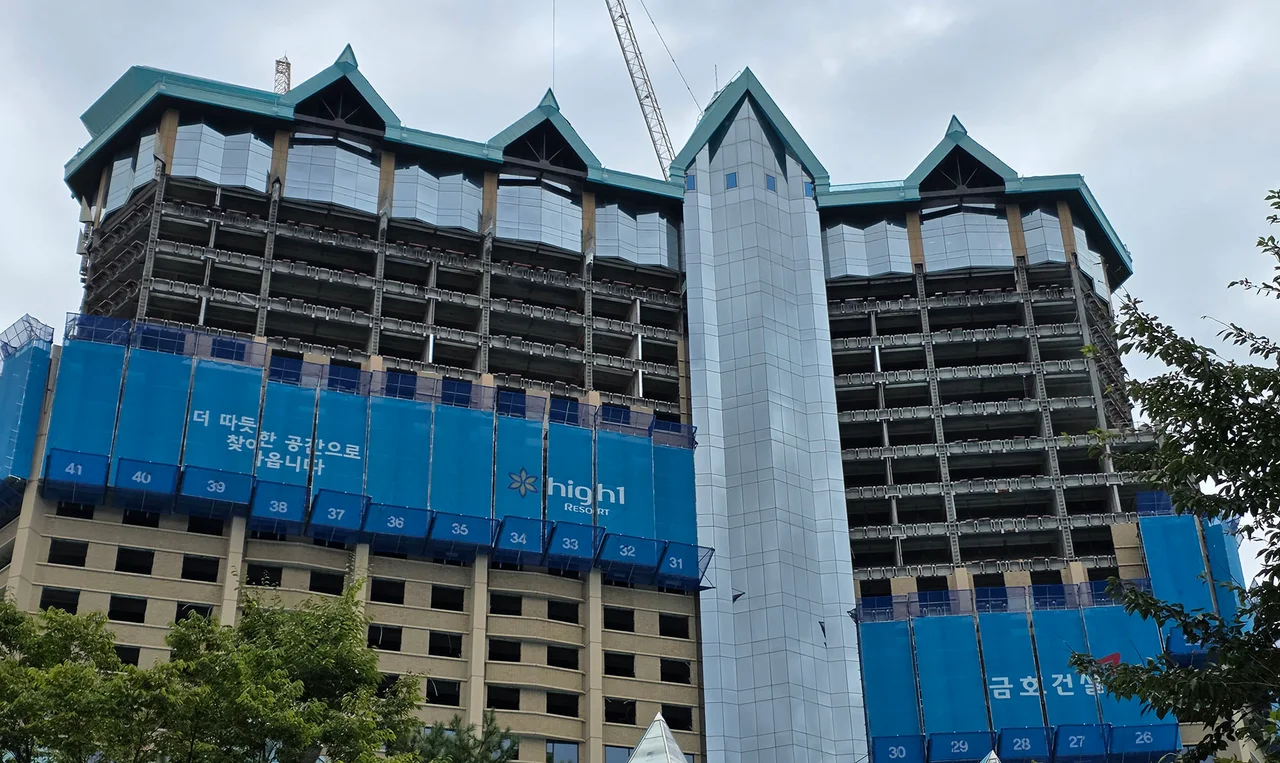
Kangwon Land has failed to maintain the revenue growth seen in the first quarter of this year, shifting to a decline in the second quarter, with third-quarter operating profits also expected to fall slightly short of market expectations. The combination of room renovations and a decrease in casino visitors has highlighted the challenge of maintaining customer influx and profitability during this investment period.
According to data citing Hana Securities estimates on the 9th, Kangwon Land's Q3 revenue is projected at 381.9 billion KRW, with an operating profit of 61.2 billion KRW. While the operating profit is about 3.8% lower than the market consensus of 63.6 billion KRW, securities firms generally evaluate this as being in line with expectations. Please note that these are brokerage estimates, not finalized financial results.
Kangwon Land's consolidated revenue for this year was 378.9 billion KRW in Q1, a 3.4% increase year-on-year, but it fell by 4.2% to 345.6 billion KRW in Q2. Operating profit also dropped from 68.9 billion KRW in Q1 to 43.2 billion KRW in Q2, representing year-on-year declines of 7.2% and 26.2%, respectively. The fact that profit declined more sharply than revenue underscores the burden on profitability.
Although the Q3 revenue forecast is about 10.5% higher than Q2, it is important to focus on why the company is struggling to exceed market expectations even during the summer peak season, rather than simply interpreting it as a continuous downward trend.
The slowdown in performance is attributed to the overlap of facility renovations and weakened casino operations. In Q2, casino accounting revenue was 319.9 billion KRW, down 3.5% year-on-year, while non-casino revenue fell 12.3% to 25.7 billion KRW. With hotel and condo revenue decreasing due to room renovations, the core casino business also failed to maintain its growth momentum.
In the general gaming area, operating revenue fell 2.4% as the number of visitors and the 'drop amount' (the amount customers exchanged for chips) decreased. In the membership gaming area, despite an increase in visitors and drop amounts, operating revenue fell 7.6% due to a lower hold rate. In essence, variables related to customer influx and gaming performance acted in tandem with the room renovations.
The business structure, which has a high proportion of fixed costs, is also a burden. Even if revenue decreases, it is difficult to reduce labor and facility maintenance costs at the same rate, which can lead to a wider decline in operating profit. Kiwoom Securities also pointed to revenue loss from room renovations and fixed cost burdens as factors for deteriorating profitability in its Q2 earnings analysis.
Kangwon Land faces the dual challenge of strengthening its mid-to-long-term competitiveness through facility upgrades while maintaining its operational base during the construction period. It is necessary to strengthen ties with local accommodations, improve transport convenience, and re-examine customer demand and service satisfaction across different casino sectors.
Q3 outlooks for foreigner-only casino operators have been mixed. Paradise is expected to outperform, with consolidated revenue of 345.2 billion KRW and an operating profit of 52.1 billion KRW, exceeding the 50.2 billion KRW consensus. This was supported by August casino revenue surpassing 100 billion KRW for the first time and a quarterly hold rate of 12.9%.
Conversely, Lotte Tour Development, operator of Jeju Dream Tower, is expected to fall significantly short of its 62.4 billion KRW operating profit target, with estimates at 177.4 billion KRW in revenue and 40.3 billion KRW in profit. GKL is also expected to miss its 18.2 billion KRW profit target, with projected revenue of 111.5 billion KRW and profit of 14.7 billion KRW. Analysts suggest that operational variables such as the strong won and hold rates have widened the performance gap between companies.
Meanwhile, Macau welcomed approximately 1.143 million visitors during the Chinese National Day holiday (Oct 1–7), with a daily average of about 163,000, a 15.5% increase compared to the same holiday period last year.