
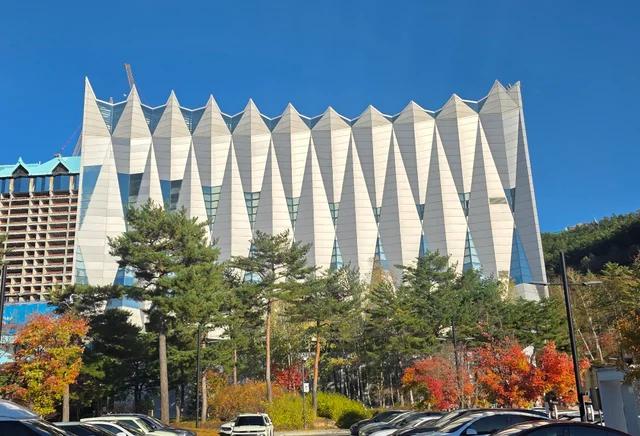
It has been 26 years since a casino was established where coal mines once stood. Kangwon Land celebrates its 26th anniversary this coming 28th.
Launched to revitalize the economy of abandoned mining regions and create jobs, Kangwon Land has generated thousands of positions and contributed vast resources to national and local finances. However, the local economy remains heavily dependent on the casino, and there are ongoing demands for improvements in services and the user environment as experienced by customers.
Kangwon Land faces complex tasks as a policy-driven enterprise tasked with saving the region, a tourism enterprise that must earn customer choice, and a casino operator that must prevent gambling addiction. In honor of its 26th anniversary, Tatata Journal examines Kangwon Land's achievements and limitations from the perspectives of customers and the local community, addressing competitiveness and mutual growth over a three-part series. (Editor's Note)
◆ Planting Jobs and Tourism in Mining Villages
The 'Special Act on the Assistance to the Development of Abandoned Mine Areas,' enacted in 1995, was designed to revive local economies stagnant due to the decline of the coal industry and to improve the lives of residents.
Based on this, the small casino opened on October 28, 2000, followed by the main casino in March 2003. As hotels, ski resorts, golf courses, and Water World were added, tourism-related industries such as lodging, dining, and transportation took root in Gohan and Sabuk.
Currently, there are about 5,800 related jobs, including approximately 3,700 direct employees and 2,100 contract workers. From opening through the end of 2025, the cumulative number of casino visitors, including repeat visits, is approximately 59.75 million. Last year alone, about 2.48 million people visited the casino.
The contribution to local finances is also significant. Of the 5.4 billion KRW in regular property taxes levied by Jeongseon-gun in July this year, Kangwon Land accounted for 2.7 billion KRW, or half of the total. This is equivalent to the entire property tax collected by the neighboring Taebaek City during the same period.
Cumulative revenue from opening through the end of 2025 exceeded 28 trillion KRW, with over 10 trillion KRW contributed to public funds, including national and local taxes, the Tourism Promotion and Development Fund, and the Abandoned Mine Area Development Fund.
However, the nature and scope of benefits for national/regional funds, Jeongseon-gun tax revenue, and local business transactions differ. Total contributions should not be immediately interpreted as direct income for local residents or as the success of regional economic self-reliance.
◆ Resources Reviving Mining Areas Start with the Customer
When discussing Kangwon Land's achievements, the customer is a stakeholder that cannot be overlooked. Casino revenue, various funds, jobs, and local consumption all begin with customer visits and spending.
However, discussions surrounding Kangwon Land tend to focus on government regulations, management performance, and regional support. The actual inconveniences customers face and the treatment they receive can be pushed to the background.
The services customers demand are not just grand facilities. Satisfaction is determined by whether entry procedures are easy to understand, whether the waiting process is fair, whether there is an opportunity to use desired games, and whether staff explanations are sufficient.
As a facility where people stay for long periods, rest areas, chairs, restrooms, smoking areas, and access to food and beverages are also critical. For electronic cards and charging facilities, the actual convenience of the user process should be the evaluation standard, rather than just whether they were introduced.
It is also necessary to go beyond just citing regulations in response to complaints; the company must explain the causes of inconveniences and share improvement results. For customers, it is more important that the problem is solved than understanding internal company divisions.
◆ Stability of Monopoly, Limits to Service Innovation
Kangwon Land is the only casino in South Korea where locals can legally enter. This monopoly has been the foundation supporting the policy goal of assisting abandoned mining areas.
At the same time, it is a structure where the pressure for service improvement through domestic competition can be weak. The fact that customers have no other domestic casino options even if they experience inconvenience is a condition the company must guard against.
It is difficult to judge that customer satisfaction is high simply because visitor numbers and revenue are maintained. Customers who continue to visit may still be dissatisfied with services, and others may reduce their visits without even raising an opinion.
This is why evaluation must center not only on staff friendliness but also on entry wait times, game access, rest conditions, and complaint resolution results. It is also necessary to examine the experiences of first-time visitors, repeat visitors, and elderly customers separately.
Identifying the games and amenities customers want and disclosing whether they have been improved can be pursued independently of large-scale development projects. Investing in new buildings and improving services to reduce daily inconveniences must go hand in hand.
◆ Public Enterprise Procedures as Customer Inconvenience
As a public enterprise, Kangwon Land is required to maintain transparent budget execution, fair contracting, and responsible decision-making. However, the fact that procedures were followed does not guarantee the adequacy of service.
Even if multiple procedures are required for facility upgrades or equipment replacement, ways must be found to reduce the time customers must endure inconvenience. It is necessary to expand the scope of what on-site staff can resolve and link recurring complaints to management's improvement tasks.
Regional mutual growth and job stability must also be aligned with customer service. Sustainability is created when local purchasing and hiring improve service quality, and satisfied customers return to visit and spend in the region, creating a virtuous cycle.
Management that evaluates both public interest and customer satisfaction is needed. As a tourism enterprise operated by customer spending, service quality is included in the public responsibilities Kangwon Land must fulfill.
◆ Poor Accessibility and Regulations… Examining the Operating Environment
Not all of Kangwon Land's limitations can be blamed on the company. It is a tourism facility in a mountainous region that takes time to reach from the metropolitan area and major airports, with limited public transportation options.
For visiting customers, transportation and accommodation costs, along with travel time, are burdens in themselves. In such conditions, if the entry and game usage processes are also complex, satisfaction will be even lower.
Government regulations such as operating hours, number of entry days, and betting limits also determine the operating environment. However, one must distinguish between constraints imposed by regulations and services the company can improve on its own. The existence of regulations cannot explain away unfriendliness or a lack of amenities.
Policy authorities must also examine the purpose and actual effects of regulations. It is necessary to evaluate and improve based on data regarding how much restrictions have reduced over-immersion and harm, and how inconveniences like waiting and congestion occur.
Regulatory adjustments should not be pursued solely based on demands for revenue growth. They will only gain persuasiveness when customer protection effects, the possibility of shifting to illegal gambling, and on-site management capabilities are reviewed together.
◆ Evaluating Regional Support and Gambling Harm Together
Kangwon Land cannot take the issue of gambling harm lightly just because it supports abandoned mining areas. Even if it helps the local economy, it is difficult to earn public trust if it leaves serious losses for individuals and families.
Service that respects customers also includes protective measures to prevent excessive use. The company must monitor signs of repeated use to recover losses and risk signals, and connect support such as counseling and usage restrictions at the necessary time.
Addiction prevention should not be left solely as the customer's personal responsibility. The company must increase the effectiveness of protective measures, the government must verify the effects of regulations, and the local community must move away from a growth model that relies only on casino revenue.
It is clear that Kangwon Land has played a significant role in preventing the collapse of the local economy. However, the shock to local businesses during the long-term closure due to COVID-19 also demonstrated the vulnerability of high casino dependency.
The report card for 26 years of operation must include not only funds, taxes, and employment scale, but also customer satisfaction, harm prevention, and the region's self-reliance capabilities.
To continue the achievements that have sustained the mining region, the company must create reasons for customers to return, and ensure those visits lead to diverse local industries and stable jobs. This is the next task that Kangwon Land, the government, and the abandoned mining regions must solve together.