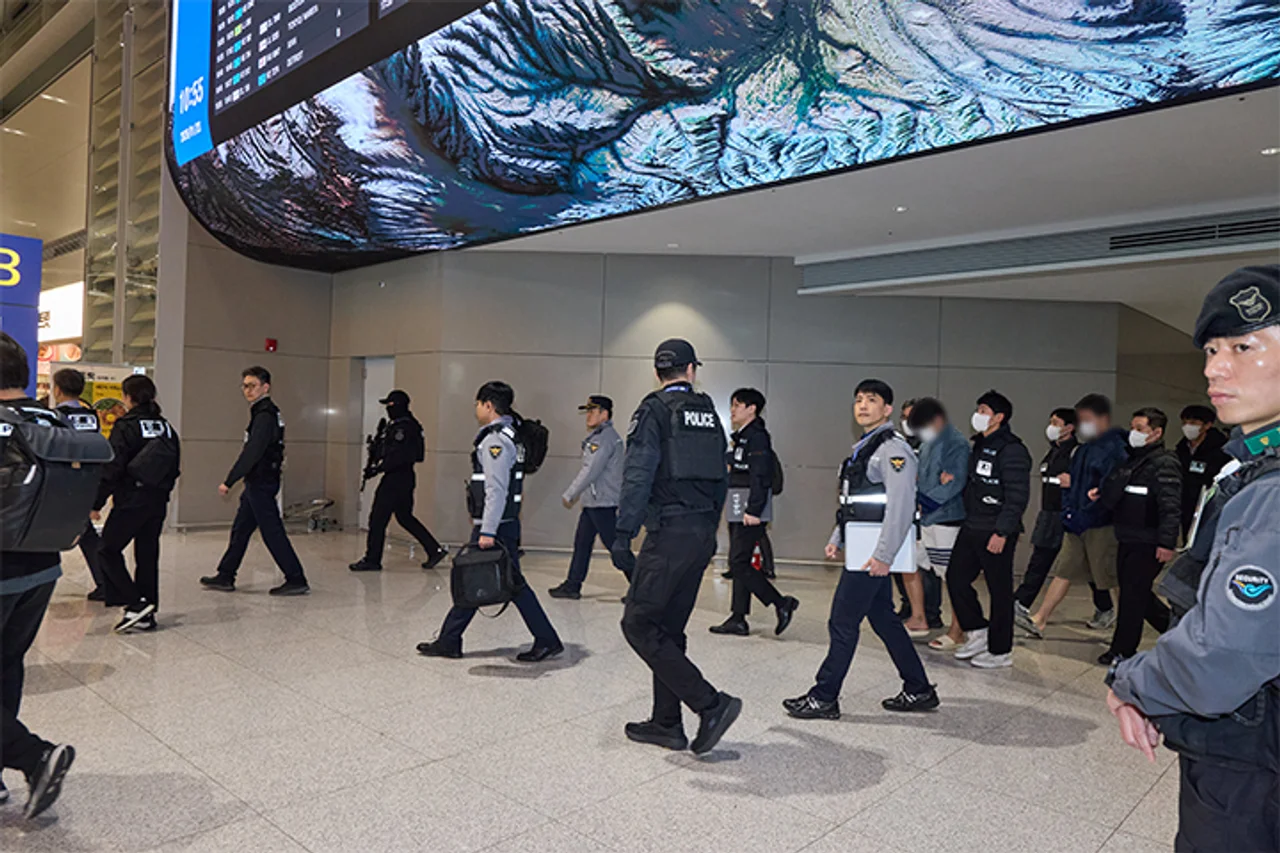
The South Korean police's investigation into illegal online gambling is evolving.
Moving away from past methods that focused solely on arresting individual site operators and users, investigations have expanded into multi-dimensional operations that track site developers, game currency suppliers, burner phone/account distribution networks, and overseas masterminds.
In particular, as the focus has shifted toward cutting off the funding sources and core supply chains of illegal gambling organizations, large-scale criminal syndicates handling hundreds of billions to tens of trillions of won are being dismantled one after another.
According to reports from the National Office of Investigation and regional police agencies on the 2nd, this year's crackdown has achieved remarkable results not only in the number of arrests but also in uncovering the operational structures of these criminal organizations.
During the intensive crackdown on cyber gambling conducted by the National Office of Investigation from last November to May, 2,319 people were apprehended across 1,746 cases, with 154 individuals detained. The total value of recovered and preserved criminal proceeds reached 107.2 billion KRW.
Since then, police across the country—including in Chungnam, Gyeongnam, and Gyeongbuk—have continued to expand the scope of their crackdowns by dismantling the production and distribution organizations of illegal gambling sites as well as their overseas-based operations.
Chungnam Police: 23 Trillion KRW in Stakes, Top-Tier Supply Chain Dismantled
A representative case symbolizing this shift in police strategy is the October 19th announcement by the Chungnam Provincial Police Agency regarding the apprehension of a supply organization behind illegal gambling sites handling 23 trillion KRW.
The Chungnam police arrested 77 individuals and detained 21, including an organization that produced and supplied 188 illegal gambling sites based in Vietnam and Cambodia.
The total amount of money handled by these sites between March 2023 and July of this year reached approximately 23 trillion KRW.
Police investigations revealed that they divided roles among suppliers who secured overseas casino footage and game currency, developers who built the sites, site operators, and recruiters.
Notably, they even recruited developers from major corporations to create software capable of launching a new gambling site in just 10 minutes.
The criminal proceeds gained by the supply and production organizations were estimated at approximately 150 billion KRW.
By analyzing 795 financial accounts and overseas messenger data, the police tracked down the upper-level organization. As a result, they shut down 188 related sites and blocked access to 408 internet addresses.
9.6 billion KRW in criminal proceeds was also preserved for pre-indictment forfeiture.
The key to this case was targeting the upper-level organization that supplied programs and game currency to numerous sites, rather than just closing down one or two individual gambling sites.
Gyeongnam Police: 153 Sites Produced, Game Currency Distribution Network Uncovered
The Gyeongnam Provincial Police Agency also achieved success in tracking the supply chain of illegal online gambling.
On September 15th, the Gyeongnam police arrested 9 members of a development and distribution organization that managed 153 illegal gambling sites and handled approximately 270 billion KRW in game currency sales, with 3 individuals detained.
They were found to have developed a system that streams overseas casino footage to domestic illegal gambling sites and supplied game currency to site operators.
The development firm received approximately 2.18 billion KRW for site production and maintenance, while a separate distribution organization handled site franchising and game currency sales.
The police preserved approximately 1 billion KRW in criminal proceeds and blocked access to 22 confirmed active sites.
Prior to this, the Gyeongnam police had already arrested 63 members of an organization operating illegal gambling sites worth 1.31 trillion KRW from an office in Vietnam, detaining 5 of them.
The Gyeongnam police's investigation demonstrates that illegal gambling organizations now possess a specialized industrial structure, going beyond simple site operation to include program development, server management, and game currency supply.
Impersonating Kangwon Land and Deepfakes: Evolving Criminal Methods
The methods used by illegal gambling organizations are becoming increasingly sophisticated.
In August, the Gyeongbuk Provincial Police Agency arrested 58 members of an organization that operated an illegal online casino by impersonating Kangwon Land, with 5 detained.
They used the Kangwon Land name and logo without authorization to promote themselves as if they were operating an official online casino.
Approximately 40,000 domestic users participated in these sites, and the deposited gambling funds were estimated at 78 billion KRW.
They even employed deceptive tactics, such as creating deepfake videos synthesizing the faces and voices of famous sports stars for use in social media advertisements.
The police tracked down the domestic mastermind, deposit/withdrawal managers, and burner account recruiters, preserving approximately 1.5 billion KRW in criminal proceeds.
This case highlights how illegal gambling crimes are now combining with high-tech video technology to exploit the credibility of legitimate casinos.
Kangwon Land does not operate any online casinos.
Therefore, one should be highly suspicious of any online gambling site using the name or logo of Kangwon Land or other legitimate domestic casinos.
Large-Scale Organizations Apprehended in Busan, Ulsan, and Chungbuk
Crackdown successes have continued across the country.
In July, the Busan Metropolitan Police Agency uncovered a burner account distribution network and a 320 billion KRW 'arbitrage' gambling organization, arresting 172 people and detaining 6.
The Ulsan Metropolitan Police Agency uncovered a 60 billion KRW illegal gambling organization that recruited users via YouTube, arresting 17 people and detaining 12.
The Chungbuk Provincial Police Agency also referred 118 members and users of an organization operating baccarat, slot machine, and sports betting sites from Vietnam to the prosecution. Funds deposited into these sites were estimated at 63 billion KRW.
The Seoul Metropolitan Police Agency uncovered an organization that used illegal sexual exploitation material distribution sites to promote gambling sites. The cumulative betting amount on these related sites was estimated at 4.7 trillion KRW, with 47.6 billion KRW in illicit profits.
As such, police investigations are expanding beyond just gambling site operations to include linked crimes such as illegal advertising, user recruitment, money laundering, and account distribution.
Overseas Masterminds Apprehended: Success in International Cooperation
International cooperation is also being strengthened against criminal masterminds who have fled the country after setting up servers and offices abroad.
On October 14th, a pan-governmental special task force on transnational crime announced that, in cooperation with UAE authorities, they had apprehended 3 individuals—including the mastermind, the deputy, and a developer—involved in operating illegal gambling sites worth approximately 3.1 trillion KRW.
They were found to have been living as fugitives abroad for a long time.
The police have repatriated the deputy and the developer to Korea and are currently pursuing the repatriation of the mastermind.
This is significant in that it shows the police are tracking the criminal proceeds and command structures of gambling organizations that once used overseas servers and third-country residency as a shield.
Accumulated Experience Since 2023: Toward Cutting Off Supply Chains by 2026
The police's intensive crackdown on illegal online gambling was strengthened following the special crackdown on youth cyber gambling in September 2023.
During the crackdown from that time until March 2024, 2,925 people were apprehended and 75 were detained, with 61.9 billion KRW in criminal proceeds recovered or preserved.
In 2024, police expanded their investigative capabilities through long-term special crackdowns, uncovering a large number of illegal gambling organizations and related sites.
In the special crackdown conducted from November 2024 to October 2025, 5,196 people were apprehended across 3,544 cases, and 314 were detained. The amount of recovered criminal proceeds was 123.5 billion KRW.
Notably, casino-type gambling accounted for 1,016 cases, the highest proportion among all cyber gambling crime types.
This year, based on this accumulated experience, the trend of tracking everything from individual operating organizations to upper-level production/supply chains, money laundering syndicates, and overseas masterminds has become distinct.
However, because the counting periods and targets differ for each special crackdown, it is difficult to judge the relative success of investigations simply by comparing the number of arrests.
The important change is that the scope of investigation is expanding beyond just the number of arrests to include the core structure of the organization and the criminal proceeds.
The Key to Eradicating Illegal Gambling is Cutting Off the Money Flow
Despite the police's massive crackdown, there are still many barriers to overcome before illegal online gambling can be eradicated.
This is because illegal gambling organizations can continue their crimes by changing internet addresses when a site is blocked, or by securing new burner accounts when deposit/withdrawal accounts are uncovered.
In particular, their methods are changing rapidly as they combine social media ads, deepfake videos, overseas servers, and burner accounts.
For this reason, it is expected that tracking money laundering routes, confiscating/forfeiting criminal proceeds, and international cooperative investigations will become even more important in the future, in addition to arresting production and distribution organizations.
Warnings and preventive education for gamblers must also be carried out in parallel. Users of illegal online gambling sites must clearly recognize that they are not just consumers, but can be subject to criminal punishment.
Furthermore, the preservation of criminal proceeds is a measure to secure assets and should be distinguished from the actual completion of national treasury recovery.
The police's crackdown achievements also need to be evaluated comprehensively, not just by the number of people arrested and the scale of the stakes, but by the actual recovery rate of criminal proceeds, whether blocked sites are reopened, and the recidivism rate of the organizations.
This year, the nationwide police investigation into illegal online gambling is at a critical turning point.
This is because it is evolving from the stage of arresting individual site operators to tracking the technical supply chains, funding sources, and overseas command structures that support the illegal gambling industry.
The war against illegal online gambling does not end with closing a few sites and arresting a few operators.
The success or failure of the investigation depends on how effectively the links are broken—where criminal organizations create new sites, recruit members, and reinvest their criminal proceeds.
The police's investigative paradigm has already begun to change. Now, the focus is on whether that change can lead to results that substantially dismantle the reproduction structure of illegal online gambling.