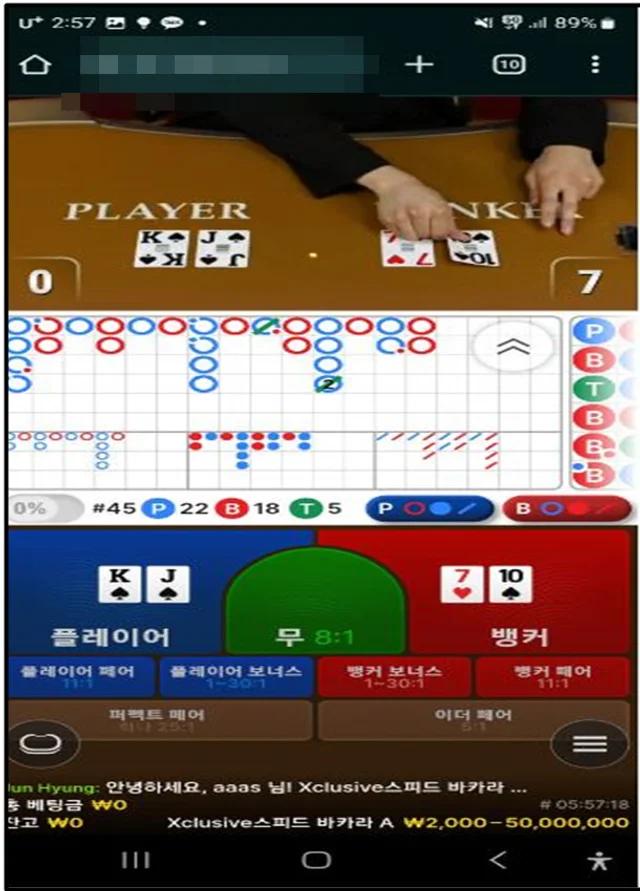
In military living quarters, soldiers use smartphones to play baccarat and engage in sports betting, borrowing money from comrades to cover stakes and failing to pay it back. Gambling habits that began in adolescence persist after enlistment and continue as debt long after discharge.
According to Tatata Journal's investigation on the 4th, recent court rulings, surveys, and reports from related agencies over the past year indicate that illegal gambling in the military has become a problem that goes beyond individual financial loss, threatening trust among peers and the stability of military service.
With increased soldier salaries providing more disposable income and the availability of smartphones after hours, experts point out the need to strengthen protective systems to block access to illegal gambling and identify high-risk groups early.
However, rather than blaming salary increases or smartphone usage as the sole causes, it is necessary to examine pre-enlistment experiences, peer relationships, stress, and the predatory structure of illegal gambling sites.
◇ 387 times in the barracks… Recent rulings show recurring gambling
According to a news report on October 29, the Daegu District Court sentenced a man in his 20s to a fine of 3 million won for repeatedly gambling on illegal internet sites while serving in the military.
This man, who served in the Navy's military police, was found to have placed 387 bets totaling 31.22 million won between November 30, 2024, and January 11 of this year, using his personal smartphone to bet on sports results and play baccarat in his living quarters. This figure represents the cumulative betting amount, which is distinct from actual losses.
There are also cases where the need for gambling funds has escalated into crimes against fellow soldiers.
In a ruling from the Gwangju District Court reported in March, a man in his 20s who served as an Air Force soldier was sentenced to two years in prison, suspended for four years, on charges including the use of forged official documents, fraud, and habitual gambling.
According to reports, he forged a military police summons to retrieve a confiscated phone he intended to use for gambling. He was also found guilty of borrowing a total of 9.56 million won from about 270 fellow soldiers without repaying them. Although the crimes occurred in 2024, the ruling was made public this year.
In August, it was reported that a man in his 20s who continued illegal gambling from before enlistment through his service was sentenced to prison for various crimes, including attempted special robbery. During the investigation, it was revealed that he had deposited a total of 145.26 million won into illegal gambling sites between November 2023 and October 2025.
While the prison sentence in this case was the result of multiple combined offenses, it cannot be concluded that gambling was the sole direct cause of the other crimes.
These cases demonstrate that gambling in the barracks is not merely a matter of curiosity but can lead to repetitive betting, financial transactions, and additional criminal activity.
◇ “Gambling that starts in adolescence doesn’t stop just because you enlist”
It is difficult to understand the full scope of military gambling by looking only at the period after enlistment.
According to a report citing the Ministry of National Defense’s ‘Military Illegal Gambling Survey’ obtained by Representative Cheon Ha-ram’s office in July, an in-depth survey of 52 individuals who engaged in illegal gambling in the military showed that about 80% had experienced illegal gambling even before enlistment or commissioning.
Based on data submitted by the Army Headquarters, the number of individuals booked for cyber gambling charges in 2025 included 20 officers and 293 soldiers, totaling 313. The total from 2021 to 2025 was reported as 1,721. This is an Army-specific statistic and does not represent the total scale of gambling experience or addiction across all military branches.
The key is that prevention and healing support must not be interrupted between school and the military. It has become clear that for young people who had recurring gambling and debt issues before enlistment, the problem does not disappear simply because the service environment has changed.
In barracks where life and leisure are shared, there is a possibility that new participants will emerge through peer recommendations or observation. There is a need for early detection and intervention to prevent individual gambling experiences from spreading to peers.
◇ Average monthly bet of 1.86 million won… Not just a soldier’s figure
In a military survey reported by the Seoul Economic Daily in August, citing data from Representative Yoo Yong-won’s office, the average monthly betting amount for those with illegal gambling experience was approximately 1.86 million won.
Methods for securing gambling funds included salaries at 64.2%, followed by the liquidation of assets such as savings, borrowing from family, and high-interest loans or credit card loans. 76.5% used personal smartphones, and 52.2% gambled after duty hours.
Caution is needed when interpreting these figures. The 1.86 million won average is neither the average for all soldiers nor the average for soldiers with gambling experience alone; it is a figure presented in a survey that includes various ranks, including officers and non-commissioned officers. Furthermore, betting amounts differ from losses, and gambling experience does not necessarily mean a clinical diagnosis of addiction.
Nevertheless, the trend of mobilizing not only salaries but also savings and loans is noteworthy. Repeatedly betting to recover losses can jeopardize not only current income but also funds meant for post-discharge life.
◇ Salaries have increased… Has the protection system strengthened accordingly?
In 2026, the monthly salary for soldiers is: ▲Private 750,000 won ▲Private First Class 900,000 won ▲Corporal 1.2 million won ▲Sergeant 1.5 million won. The levels increased in 2025 are being maintained this year.
Compared to 2024, salaries have increased across all ranks.
First, the salary for a Private increased by 110,000 won from 640,000 won (2024) to 750,000 won (2025), and for a Private First Class by 100,000 won from 800,000 won to 900,000 won.
Subsequently, Corporals saw an increase of 200,000 won from 1 million won to 1.2 million won, and Sergeants an increase of 250,000 won from 1.25 million won to 1.5 million won. (These are salary standards and exclude government support funds for the Soldier’s Tomorrow Preparation Savings account.)
Salary increases are a policy to enhance compensation for service and assist in financial independence. The fact that gambling cases occur cannot be used to question the improvement of treatment itself.
However, as more young people manage regular salaries and lump sums for the first time, education and counseling on financial management and the risks of illegal gambling must be strengthened to reflect reality.
In August, the Financial Services Commission also diagnosed that while financial assets managed directly by military personnel are increasing, so is the risk of exposure to online gambling, high-risk investments, and high-interest loans.
According to authorities, the outstanding loan balance for military personnel from the top 30 registered lenders was 44.4 billion won at the end of 2025. In the same year, 432 military personnel received debt adjustments from the Credit Counseling & Recovery Service, with support totaling about 10.2 billion won. However, not all of these loans and debts were caused by gambling.
◇ Smartphones are the gateway… Time restrictions are not enough
Describing soldier smartphone usage as 'unlimited freedom' is inaccurate.
Current unit management regulations generally set smartphone usage for personnel as 6:00 PM to 9:00 PM on weekdays after duty, and 8:30 AM to 9:00 PM on holidays. Commanders may adjust this within a range that does not interfere with operations and training.
The problem is that illegal sites can be accessed via smartphone even during permitted times. Measures to set usage times and measures to reduce gambling risks must complement each other.
Education on identifying gambling advertisements and sites, blocking peer-to-peer recruitment, and linking counseling for repetitive borrowing and loss-chasing behavior are necessary. Professional healing support must follow for soldiers who have already developed problems.
Financial transactions between comrades living together must also be monitored. While distinguishing between simple small-sum borrowing and repetitive funding, situations where gambling debt spreads to harm other soldiers must be prevented.
◇ Hiding out of fear of punishment delays treatment
Experts emphasize that procedures for holding individuals accountable and procedures for helping them recover must be established together.
Lee Yoon-ho, a professor of police administration at Dongguk University, explained in a media interview in July, "Who would voluntarily report if they are only going to be punished?" and highlighted the need for a voluntary reporting system accompanied by treatment. Seol Dong-hoon, a sociology professor at Chonbuk National University, pointed out the characteristics of peer culture spreading in communal living and suggested linking with professional healing institutions.
In a response submitted to Representative Cheon Ha-ram’s office in August, the Ministry of National Defense stated that it is reviewing the implementation of a voluntary reporting system for illegal gambling among military personnel. This response should not be interpreted as a confirmation of the system's implementation or automatic immunity.
It is important to guide soldiers so they understand what support they can receive if they request counseling, how personal information is protected, and how the handling of illegal acts and healing can proceed in parallel.
◇ Government joint response… Must continue after discharge
The government has also begun a joint response to the military gambling problem.
On September 17, the National Gambling Control Commission, the Ministry of National Defense, the Financial Services Commission, the Financial Supervisory Service, and the Korea Center on Gambling Problems and Recovery signed a memorandum of understanding (MOU) to support the prevention, healing, and recovery of gambling problems among military personnel.
The key is to connect prevention education, early detection, professional counseling/healing, and financial/debt support. At a policy forum, opinions were raised that an environment should be created where soldiers can request help without burden, and that counseling started during service should not be disconnected after discharge.
Future evaluations should not stop at the number of MOUs signed or education sessions held. It is necessary to verify how early high-risk groups are discovered, whether soldiers who applied for counseling were actually connected to treatment and debt support, and whether they continue their recovery after discharge.
Salary is money for young soldiers to prepare for their future. If that money flows into illegal sites and the burden of debt is shared with colleagues and family, we must ask whether the safety net in the barracks is doing its job.
Responding to the gambling problem among military personnel does not end with holding them accountable for illegal acts. It must lead to a system that examines risks before enlistment, prevents the spread during service, and supports recovery even after discharge.